Latest

Cambodian shoe factory collapse kills 2, injures 7

201351651659352734_20[Third World people die for fashion. Third World people toil in unsafe conditions to keep First World people comfortable, to prop up the First World way of life. -- NP]

Cambodian shoe factory collapse kills 2, injures 7

By SOPHENG CHEANG

PHNOM PENH, Cambodia (AP) — The ceiling of a Cambodian factory that makes Asics sneakers collapsed on workers early Thursday, killing two people and injuring seven, in the latest accident to spotlight lax safety conditions in the global garment industry.

About 50 workers were inside the factory south of Phnom Penh, the capital, when the ceiling caved in, said police officer Khem Pannara. He said heavy iron equipment stored on the floor above appeared to have caused the collapse.

Two bodies were pulled from the wreckage and seven people were injured, he said. Rescuers combed through rubble for several hours and after clearing the site said that nobody else was trapped inside.

At a clinic where she was being treated for her injuries, worker Kong Thary cried on the telephone as she recounted the collapse.

“We were working normally and suddenly several pieces of brick and iron started falling on us,” the 25-year-old said.

An initial investigation showed the ceiling that collapsed was poorly built and lacked the proper building materials to support heavy weight, said Ou Sam Oun, governor of Kampong Speu province, where the factory was located.

Chea Muny, chief of a trade union for factory workers, identified the factory as a Taiwanese-owned operation called Wing Star that produces sneakers for Asics, a Japanese sportswear label. He said shoes made at the factory were imported to the United States and Europe.

An Asics spokeswoman in Tokyo confirmed the factory was in contract to make Asics running shoes. She said Asics was trying to determine what happened.

“We understand that some people have died, so first we offer our condolences,” said spokeswoman Masayo Hasegawa in Tokyo. She said she did not have information on the last time the building structure had been inspected but added, “We want the highest priority to be placed on saving lives.”

The factory complex, which opened about a year ago, consists of several buildings and employs about 7,000 people, said Pannara, the police officer. The structure where the collapse occurred was mainly used as a storage warehouse for shoe-production equipment but had a small work area for about two dozen people, Chea Muny said.

The garment industry is Cambodia’s biggest export earner, employing about 500,000 people in more than 500 garment and shoe factories. In 2012, the southeast Asian country shipped more than $4 billion worth of products to the United States and Europe.

The accident comes about three weeks after a building collapse in Bangladesh killed 1,127 people in the global garment industry’s deadliest disaster.

“This shows that the problem is not only isolated to Bangladesh, and that companies (elsewhere) are trying to drive prices down by taking shortcuts on workers’ safety,” said Phil Robertson of Human Rights Watch.

Last month, the U.N.’s labor office released a report that called for “urgent attention” to worker safety violations in the Cambodian garment and footwear industry.

The report by the International Labor Organization found “a worrying increase in fire safety violations,” including that only 57 percent of factories kept paths free of obstructions. It reported “unacceptable” heat levels, abuse of overtime hours and a lack of worker access to drinking water.

Honduran police accused as death squads

 Honduran-National-Police-e1364148883167

[The United States has a long history of terrorizing the masses of Latin America. --NP]

Honduran police accused as death squads

By ALBERTO ARCE

TEGUCIGALPA, Honduras (AP) — At least five times in the last few months, members of a Honduras street gang were killed or went missing just after run-ins with the U.S.-supported national police, The Associated Press has determined, feeding accusations that they were victims of federal death squads.

In a country with the highest homicide rate in the world and where only a fraction of crimes are prosecuted, the victims’ families say the police are literally getting away with murder.

In March, two mothers discovered the bodies of their sons after the men had called in a panic to say they were surrounded by armed, masked police. The young men, both members of the 18th Street gang, had been shot in the head, their hands bound so tightly the cords cut to the bone.

That was shortly after three members of 18th Street were detained by armed, masked men and taken to a police station. Two men with no criminal history were released, but their friend disappeared without any record of his detention.

A month after the AP reported that an 18th Street gang leader and his girlfriend vanished from police custody, they are still missing.

The 18th Street gang and another known as Mara Salvatrucha are the country’s biggest gangs, formed by Central American immigrants in U.S. prisons who later overran this small Central American country as their members were deported back home. Both engage in dealing drugs and charging extortion fees under threat of death. Now the 18th Street gang says its members are being targeted by police death squads, described by witnesses as heavily armed masked men in civilian dress and bullet-proof vests who kill or “disappear” gang members instead of bringing them to justice.

In the last two years, the United States has given an estimated $30 million in aid to Honduran law enforcement. The U.S. State Department says it faces a dilemma: The police are essential to fighting crime in a country that has become a haven for drug-runners. It estimates that 40 percent of the cocaine headed to the U.S. — and 87 percent of cocaine smuggling flights from South America — pass through Honduras.

“The option is that if we don’t work with the police, we have to work with the armed forces, which almost everyone accepts to be worse than the police in terms of … taking matters in their own hands,” U.S. Assistant Secretary of State William Brownfield told the AP via live chat on March 28. “Although the national police may have its defects at the moment, it is the lesser evil.”

Alba Mejia, Deputy Director of the Committee for the Prevention of Torture, said her group has documented hundreds of death squad cases in the country since 2000. The squads burst into homes with no warrants and take away young men, she said.

“We are convinced that there is a government policy of killing gang members and that there is a team dedicated to this activity,” Mejia said. Federal prosecutors say they have received about 150 complaints about similar raids in the capital of Tegucigalpa over the last three years.

The 18th Street gang originated in Los Angeles and spread through Central America after many of its members were deported in the 1980s and early 1990s. In Honduras, the gang controls entire neighborhoods, with entrance impossible for outsiders, while gangsters extort what is called a “war tax” on small business owners and taxi drivers, even schools and corporations.

Drug cartels, which are much larger than the gangs, oversee the movement of cocaine from South America northward to the United States. It is widely believed that the cartels pay the gangs in drugs for protection and assistance in moving the narcotics, and as a result the gangs fight each other over the territory.

Honduran National Police spokesman Julian Hernandez Reyes denied the existence of police units operating outside the law. He asserted that the two gangs are murdering each other while disguised as law enforcement.

“There are no police death squads in Honduras,” Hernandez said in an interview. “The only squads in place are made of police officers who give their lives for public safety.”

But there is mounting evidence of the existence of squads of police in civilian dress, apparently engaged in illegal executions.

An AP reporter covering the aftermath of an April 7 shootout between police and gang members saw one such squad, whose masked members were directing more than 100 uniformed policemen in an offensive against gang members. The officers had surrounded a house where two gangsters had holed up after a chase with police. Witnesses said that when one walked out with his hands up, masked police shot him dead. “Killers! Killers!” a crowd of women shouted.

Last year, the U.S. Congress withheld direct aid to Honduran police chief Juan Carlos Bonilla after he was appointed to the top law enforcement post despite alleged links to death squads a decade earlier. Bonilla, nicknamed “the Tiger,” was accused in a 2002 internal affairs report of involvement in three homicides and linked to 11 other deaths and disappearances. He was tried in one killing and acquitted. The rest of the cases were never fully investigated.

The U.S. State Department has resumed funding to the Honduran police, but said the money only supports units vetted by the U.S. So far this year, the U.S. has provided $16 million to the police force, and argued last month that the money isn’t sent directly to Bonilla or any of his top 20 officers.

U.S. Sen. Patrick Leahy of Vermont, chairman of a Senate Appropriations subcommittee on the State Department and foreign operations, has led a group in Congress concerned about the alleged human rights abuses, and has held up $10 million, despite State Department pressure.

“A key question is whether we should provide aid, and if so under what conditions, to a police force that is frequently accused of corruption and involvement in violent crimes,” Leahy said. “If there is to be any hope of making real progress against lawlessness in Honduras, we need people there we can trust, who will do what is necessary to make the justice system work. That is the least Congress should expect.”

Two weeks before a visit to Central America by President Barack Obama, U.S. Sen. Robert Menendez of New Jersey toured Honduras amid questions over how U.S. aid is spent.

“I understand that there are concerns among my colleagues in both the Senate and House about certain U.S. assistance to Honduras,” said Menendez, chairman of the Senate Foreign Relations Committee. “The U.S. has a moral and legal authority to ensure U.S. assistance is not tainted by human rights concerns.”

The latest string of attacks began with gang leader Kevin Carranza Padilla, who disappeared with his girlfriend, Cindy Yadira Garcia, on Jan. 10. Witnesses said he was arrested, and a police photo leaked to the local press showed Carranza with his hands tied and face duct-taped. The couple has not been seen since, and police say they were never arrested.

In March, Carranza’s close friend, Billy “Babyface” Jovel Mejia, 23, and another gang member, Wilder Javier “Sadboy” Alvarado, 20, were on the run, changing houses every couple of days, when they called a friend to say they had been surrounded by police.

A woman named Kelsa, who asked that her last name not be used for fear of reprisals, had helped the two hide out. She told the AP of a call one night from a panicked Jovel, whom she quoted as saying: “The police are coming for us. They are going to enter the house. Tell our families that they are coming to kill us.”

“I could hear pounding.” she said. “Billy told me he couldn’t explain what house they were at. … I could hear screams. Billy left the phone and then the call dropped.”

As often happens in such cases, his mother, Maria Elena Garcia, went from station to station in search of information from police.

“I went to the 4th district, from there they sent me to the 7th, then to the metropolitan police headquarters,” Garcia said. “At 5 a.m. they called me to tell me that they had found two bodies.”

Garcia and Alvarado’s mother identified their sons, whose bodies were found dumped at the edge of the capital. Each had a single 9 millimeter gunshot to the head, and their hands were tightly bound. Jovel was missing his right eye, Alvarado his left.

“The blood was still fresh and the bullets were still there,” Garcia said.

Alvarado’s mother, Norma, said police had raided her home at least six times in search of her son in a neighborhood called the United States, one of many named for a country.

She described the same routine each time: They would come in civilian clothes with bullet-proof vests and ski masks and identify themselves as police. They were teams of six to eight men in large, expensive SUVs without license plates.

“There were times when I would close the door to give him time to escape,” she said. “They even came on New Year’s Eve.”

In the middle of the night on Feb. 14, six masked men who identified themselves as police took Alvarado’s 13-year-old grandson.

She told them he was studying, that he was a good boy.

“I begged them not to take him, not to kill him,” Alvarado told the AP, crying. “There was only one car outside our door, but at each end of the street there were more cars. It was a big operation.”

The boy, whose name is being withheld because he is a minor, said in an interview that they covered his face with his own shirt and pushed him to the floor of the SUV. Two agents kept him down with their feet while another drove the car around for half an hour, asking about Wilder, the boy’s cousin.

“They wanted to know where my brother was. They thought Wilder was my brother. They wanted to know where the weapons were,” the boy said. “They kept punching me, and because I wasn’t telling them anything, they would punch me more.”

The boy was taken to an office.

“They were six men. I could only see them when they took the shirt off of my face to put a black, plastic bag over my head. They always wore the ski masks. I was sitting down and they were asphyxiating me with the bag. When I would faint they would beat me up to wake me up and they would do it again,” he recalled.

The boy said he could see photos of 18th Street gang members pinned to the walls.

He doesn’t know why, but suddenly they let him go, and the following day his family filed a complaint with the prosecutors’ office. They have heard nothing about the investigation.

The 18th Street gang leaders told the AP that the attacks against its members are not the work of rival gangs. Members say police have declared war on them, especially in the southeast Tegucigalpa neighborhood once led by Carranza.

Carranza’s partner, Elvin Escoto Sandoval, known as “Splinter,” was detained by police on March 13, according to his wife, Doris Ramirez, now seven months pregnant with their first child. Nilson Alejandro “The Squirrel” Padilla, 21, said he was taken into custody along with Splinter and another member identified only as “Chifaro.”

“There were seven in civilian clothes, bulletproof vests, ski masks, automatic rifles, and a police badge hanging with a string from their neck. They pushed me against the ground and told me not to lift my head. They were traveling in two cars,” Padilla recalled.

“They took us to the National Criminal Investigations offices,” he added. “They told me and Chifaro that we didn’t have a record and we were released that afternoon. They didn’t even question us.”

By then, Ramirez was at the station, asking police about the fate of her husband, “Splinter.”

Police told her they had only detained two men, not three, she said.

“We then went to all the police stations in the area and finally filed a complaint on his disappearance at the police headquarters,” she said.

Ramirez still goes to the morgue every time she hears of an unidentified body. She has also been to the “little mountain,” a known dumping ground outside Tegucigalpa for bodies of murdered young men. Her husband has disappeared.

Chifaro is missing now, too.

Bahrain demonstrator jailed for flag ‘insult’

bahrainprotests1602

[The United States backs the dictatorship in Bahrain even as it tramples civil rights. The United States is only about advancing its own interests. --NP]

Bahrain demonstrator jailed for flag ‘insult’

MANAMA, Bahrain (AP) — A Bahrain demonstrator was sentenced to three months in prison Thursday for hanging a Bahrain flag from his truck during a 2011 rally, a defense lawyer said, in one of the first cases based on tougher codes for alleged insults to the Gulf nation’s ruler or symbols.

The specific charges were unclear, but prosecutors argued that draping the flag over the truck during the protest gathering was an offense under the new rules.

Many people in Bahrain, however, fly flags from vehicles during celebrations and other events. Flags also are common during anti-government marches.

In April, Bahrain announced stricter penalties for insulting the Gulf state’s king or national symbols. The measures seek to quell more than two years of protests led by Bahrain’s majority Shiites seeking a greater political voice in the Sunni-ruled nation.

Defense lawyer Hashim Saleh said 62-year-old Abdulla al-Sayegh plans to appeal the sentence and the 100 dinar ($265) fine. Al-Sayegh acknowledged he attended pro-reform rallies during the early days of the Arab Spring uprising.

On Wednesday, six Twitter users in Bahrain were given one year each in prison for posts deemed offensive to the king.

Palestinians mark their 1948 displacement

Palestine

[The US-backed genocide against the Palestinian people continues. -- NP]

Palestinians mark their 1948 displacement

By MOHAMMED DARAGHMEH

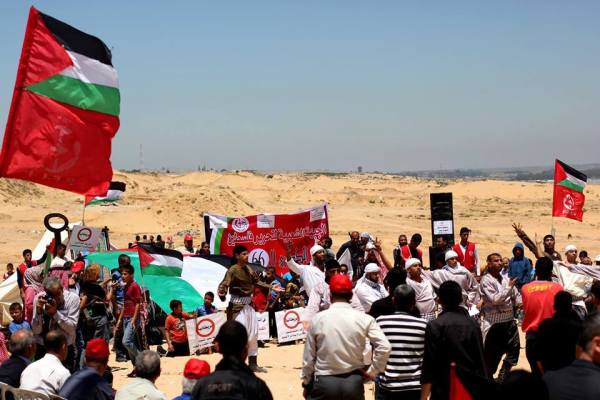
RAMALLAH, West Bank (AP) — Tens of thousands of Palestinians marked the 65th anniversary of their mass displacement during the war over Israel’s 1948 creation, marching in the streets and in some parts of the West Bank clashing with Israeli security forces.

Every May 15, Palestinians hold rallies to commemorate the “nakba,” or “catastrophe” — the term they use to describe the displacement, when hundreds of thousands of Palestinians fled or were driven from their homes during the fighting. The dispute over the fate of those Palestinians and their descendants, now numbering several million people, remains at the core of the Arab-Israeli conflict.

The United Nations General Assembly approved a partition of British-ruled Palestine into separate Jewish and Arab states in 1947. In May 1948 Israel declared independence.

Israel views the Palestinians’ return as demographic suicide and expects the displaced and their descendants to be taken in by a future Palestinian state. But intermittent Israeli-Palestinian attempts to agree on the terms of such a state have so far failed.

Across the West Bank on Wednesday, sirens wailed at noon for 65 seconds to commemorate the 65 years since the “nakba.” Thousands marched in Ramallah from the grave of the late Palestinian leader Yasser Arafat to the city center. Many wore black in a sign of mourning, holding Palestinian flags and large keys symbolizing the homes they left behind.

“The right of return will not die,” chanted the protesters. Schools closed at midday and parents brought their children to the demonstration.

In Ramallah, 38-year-old Manwal Awad brought her 11-year-old twins to the protest. “Every year I bring them with me to inherit the story of our nakba, and to keep the dream of return,” she said.

Rallies were elsewhere in the West Bank as well, and in several places demonstrators throwing rocks clashed with Israeli security forces, who responded with tear gas, Israel’s military said. Near the volatile city of Hebron, a fire bomb hit at an Israeli military vehicle, causing it to overturn and injuring four soldiers, the military said.

In east Jerusalem, Israeli police used water cannon and officers on horseback to disperse an “illegal march,” police spokesman Micky Rosenfeld said. Nineteen protesters were arrested for throwing rocks and bottles at police that injured three police officers, he said.

Seven other Palestinians suspected of attacking several Jews as they walked to the Western Wall in the Old City were also arrested, he said.

In Gaza, around a thousand people marched to the U.N. headquarters in Gaza City, where the demonstrators chanted: “We shall return. We will never give up or compromise over our land.”

Militants in Gaza, which has been under the control of the militant Hamas group since 2007, fired a rocket into southern Israel that exploded in an open field causing no injuries, Israel’s military said.

In a televised speech on Tuesday night, Palestinian President Mahmoud Abbas said the Palestinian cause earned international acceptance last year with the United Nations’ de facto recognition of a Palestinian state in east Jerusalem, the West Bank and the Gaza Strip.

“We won the support of the world,” Abbas said, adding that Israel’s policies toward the Palestinians are “condemned internationally.”

Last year, Abbas created a stir when he told Israeli media that he himself has no wish to live in Safed, the city of his birth, in northern Israel.

Although widely condemned by Palestinians, Abbas’ remarks were seen as a reflection of a decades-old understanding among Palestinian officials that likely only a limited number of refugees would ever be able to return to their original homes in Israel as part of a compromise that would result in a future peace agreement.

U.S. Secretary of State John Kerry has been trying to renew Israeli-Palestinian negotiations, which collapsed four years ago over the issue of Jewish settlements. Palestinians insist they will not resume talks unless the construction of settlements in territories they want for their future state ends first. Israel says negotiations should resume without preconditions and that settlements will be resolved through talks along with the other issues.

In efforts to jump-start the talks, Kerry has managed to persuade Arab leaders to reissue their 2002 peace proposal with new incentives, including a suggestion that final borders between Israel and a future Palestine could be modified from the 1967 lines through agreed land swaps.

The 2002 initiative, which at the time was endorsed by the Arab League and the 57-member Organization of Islamic Cooperation, offered Israel normalized relations in exchange for a full withdrawal from territories captured in 1967. However, it was overshadowed by Israeli-Palestinian fighting and was greeted with skepticism by Israel.

Israel has been mostly quiet on the proposal so far.

On Wednesday, the Palestinian statistics bureau in the West Bank issued a statement saying the number of Palestinians today has reached 11.5 million. Of those, 4.4 million live in the West Bank, east Jerusalem and Gaza; 1.4 million in Israel while the remainder live in the diaspora.

___

Associated Press writer Ibrahim Barzak contributed to this report from the Gaza Strip.

Bahrain convicts 6 of Twitter insults

353446-mideast-bahrain-protests[The US-backed dictatorship in Bahrain has brutally attacked protesters. The United States claims to stand for democracy in Syria, but supports the brutal attacks on the masses in Bahrain. Just goes to show that so-called "human rights" and "democracy" are just rhetoric. What matters to the imperialists is advancing the interests of imperialists.  -- NP]

Bahrain convicts 6 of Twitter insults

MANAMA, Bahrain (AP) — A lawyer says Bahraini courts have sentenced six people to a year in prison on charges of making Twitter posts deemed offensive to the Gulf nation’s king.

The convictions Wednesday are part of wider crackdowns across Gulf Arab states against perceived dissent expressed on social media, including imposing tougher media laws.

Lawyer Shahzalan Khamis says the prosecution claimed the six suspects violated laws with posts critical of Bahrain King Hamad bin Isa Al Khalifa. No other details on the posts were made public.

Bahrain has been gripped by more than two years of unrest between the Sunni-led government and the kingdom majority Shiites seeking a greater political voice.

Bahrain is home to the U.S. Navy’s 5th Fleet.

Longer US white majority if immigration slows Census

Barak Obama-United States-Politics

[What has emerged in the United States is a multinational empire. Not only do Whites receive the benefits of empire, but so too do other national groups and minorities. Soon Whites will not be the majority in the United States. The face of empire in North America will not only be White, but Black, Latino, etc. Barack Obama is the new face of empire. -- NP]

Longer US white majority if immigration slows Census: Whites hold US majority 3 years longer, population slows, if immigration growth slows

By Hope Yen

WASHINGTON (AP) — Without increased immigration, whites would lose their U.S. majority in 2046, three years beyond official projections, and the nation’s population would not reach 400 million until after 2060, a decade or more later than forecast, according to census estimates Wednesday.

In all, immigration will surpass natural increase — births minus deaths — as the main driver of population growth by midcentury, the Census Bureau said.

The new numbers show how projections could vary from last year’s government prediction that white children will become a minority in 2018 and the overall white population will follow in 2043, based on what happens to the economy and immigration policy. As a whole, the U.S. population is projected to climb to 400 million by 2051. Those dates remain the official census projections, and they are based on the assumption that immigration continues to climb.

The 2046 estimate of a white minority is one of three new alternative projections based on rates for births and deaths and a scenario in which immigration follow its recent slower pace of adding more than 700,000 foreigners each year.

In general, demographers have said that scenario offers an instructive look at the future demographic makeup based on current conditions, in which the economy does not significantly strengthen or weaken and immigration policies are unchanged.

The actual shift in demographics will be influenced by factors that can’t accurately be forecast. They include the pace of the economic recovery, cultural changes, natural or manmade disasters, as well as any overhaul of immigration laws based on legislation now being debated in Congress.

The United States has 315 million people today; less than 64 percent are non-Hispanic whites.

In a situation where immigration levels remain constant for the next half-century, the total population would climb to 392.7 million by 2060, with whites making up 44.7 percent of the population. Blacks would make up 12.7 percent, virtually unchanged from today. Hispanics, now 16 percent of the population, would rise to 29 percent by that year.

Asians would increase from 5 percent of the population to 7.5 percent.

The point when minority children become the majority would be delayed one year from the official projection, from 2018 to 2019.

The population 65 and older would grow rapidly, outnumbering the under-18 age group by 2038. Under the official prediction, that tipping point occurs much later, in 2056.

The Census Bureau’s varying sets of projections show immigration’s role in replenishing the population. As in many industrialized nations, the U.S. is slowly aging due to rising median age and lower birth rates.

Under the official projections released last December, immigration will become the main driver of U.S. growth by 2032. That would be the first time that natural increase from births was not the leading cause of population increase since at least 1850, putting the U.S. in the company of many other industrialized nations such as Japan and Italy that long have struggled with low growth rates.

“As a whole, the U.S. population is projected to grow more slowly, the older population is expected to grow much larger, and the minority population will grow faster,” said Jennifer Ortman, a Census Bureau demographer. “Most of the immigrants coming into the U.S. population are roughly 15 to 45 years old, so we see that immigration is bolstering the working-age population and helping it to grow.”

Several demographers say the current Senate immigration bill could change the U.S. race makeup by tightening border security and placing a higher priority on granting employment-based visas for high-skilled workers. Those changes are likely to result in a greater influx of Asian immigrants compared to Latinos.

The Center for American Progress, a liberal think tank, estimates that as a whole 150,000 fewer immigrants will enter the U.S. if the Senate bill becomes law. That is due mostly to an estimated sharp decline in illegal border crossings.

The Census Bureau says its projections should be used mostly as a guide.

The agency also released numbers showing projections based on “high” rates of immigration — more likely if government policies become more flexible and a booming U.S. economy attracts large numbers of foreigners — as well as “low” rates of increasing immigration, a possible scenario if U.S. policies don’t change much while the economy improves.

—With high immigration, the minority “tipping point” is moved up to 2041, two years earlier than the previous estimate. At that time, Asians would have a much larger share, at 9 percent, because their population growth is more dependent on immigration than birth rates. The U.S. population would reach 400 million by 2044.

—With low immigration, the “tipping point” arrives by 2045.

—The share of the working-age population, age 18 to 64, is expected to decrease based on all four projection scenarios. The official projections show that group dropping from 62.7 percent in 2012 to 56.9 percent by 2060.

—In each of the four projections, the 65 and older age group would rise from 13.7 percent to more than 20 percent by 2060.

“Despite projected declines in fertility, these projections make plain that we are on the road to becoming a highly diverse nation,” said William H. Frey, a Brookings Institution demographer. “Even under the lowest immigration assumptions, the nation will become minority white in 33 years. So those who believe that barring immigration will make the nation appreciably less diverse need to take heed of these projections.”

Bangladesh to allow unions for garment workers

bangladeshi-factory-workers[Only after multiple, high-profile disasters in the industry, only after the deaths of over 1,000, are unions allowed to form. Only after so much blood, is the industry wage improved. While these reforms are fine, they are simply reforms. They are mere crumbs. Too little, too late. Exposing reformist ploys to quash more radical trends is one aspect of care work, Leading Light Communist work among the masses. Lenin showed that economist struggles by themselves, trade-union struggles, for example, will not lead to revolution. Rather, revolutionary organizing supports economist struggles of the exploited workers, revolutionary activists intervene, they lead. Thus they build connections with the trust of the people. As The Leading Light states, "A communist who does not lead is not a communist." Revolutionary cadre, through patient interaction with and education of the masses, demonstrates to them how such local, limited appeals to the stomach, the  immediate economic interests, are connected to a bigger picture of fighting imperialism, saving the planet, transfer of power to the poor, ending all systematic oppression, creating Leading Light Communism. The revolutionary activist shows the masses that the struggle is not over simply when "we get ours," when we win this or that economic struggle, when we win some benefits for ourselves. Rather, nobody is truly free unless we all are. The struggle does not end when we win a local fight. Rather, the struggle is just beginning. Our struggle will not end until we reach true equality for all, until we break all chains of oppression, until the red sun of Leading Light Communism pierces the night and brings about our new day. This revolutionary road is a long march, a protracted struggle. It is full of twists and turns. To really reach our goal, we need a measured character and discipline that understands this journey is a long one filled with many victories and many defeats. We should not get wildly optimistic after a single victory or crushingly depressed after one defeat. The cadre should be a model to those she or he leads. The cadre should coolly take success or defeats as they happen, providing analysis, educating those around them. When demoralization occurs amongst the masses, the role of the cadre is to raise spirits through an analysis that brings people back to the big picture and the protracted nature of struggle. The cadre keeps those they organize with on point. The cadre returns, again and again, to the important point. The cadre make up the backbone of the revolution. To become a cadre is a privilege and responsibility. To be a cadre is to take personal responsibility for both victories and defeats, personal responsibility in bringing the better world into being. The cadre understands that they are condemned to lead. It is the growth of real communist organization that the capitalists fear in Bangladesh. When garment workers in Bangladesh become union organizers, the capitalists are irritated. When garment workers workers in Bangladesh become cadre, communist soldiers of the Leading Light, the capitalist's worst nightmare begins to materialize right in front of him. Let us make something lasting and positive emerge from the tragedies that so plague the garment industry here. Let us strengthen ourselves. Let us educate. Let us become Leading Lights for all the world to see. -- NP]

Bangladesh to allow unions for garment workers

By FARID HOSSAIN

DHAKA, Bangladesh (AP) — Bangladesh’s government agreed Monday to allow the country’s garment workers to form trade unions without prior permission from factory owners, the latest response to a building collapse that killed more than 1,100 people and focused global attention on the industry’s hazardous conditions.

The Cabinet decision came a day after the government announced a plan to raise the minimum wage for garment workers, who are paid some of the lowest wages in the world to sew clothing bound for global retailers. Both moves are seen as a direct response to the April 24 collapse of an eight-story building housing five garment factories, the worst disaster in the history of the global garment industry.

Government spokesman Mosharraf Hossain Bhuiyan said the Cabinet approved an amendment to the 2006 Labor Act lifting restrictions on forming trade unions in most industries. The old law required workers to obtain permission before they could unionize.

“No such permission from owners is now needed,” Bhuiyan told reporters after the Cabinet meeting presided over by Prime Minister Sheikh Hasina. “The government is doing it for the welfare of the workers.”

Local and international trade unions have long campaigned for such changes.

Though the 2006 law technically allowed trade unions — and they exist in many of Bangladesh’s other industries — owners of garment factories never allowed them, saying they would lead to a lack of discipline among workers.

Trade union leaders responded cautiously.

“The issue is not really about making a new law or amending the old one,” said Kalpana Akter of the Bangladesh Center for Workers Solidarity, a group campaigning for garment workers’ rights. “In the past whenever workers tried to form associations they were subjected to beatings and harassment,” she said. “The owners did not hesitate to fire such workers.”

In recent years the government has cracked down on trade unions attempting to organize garment workers. In 2010 Hasina’s government launched an Industrial Police force to crush street protests by thousands of workers demanding better pay and working conditions.

That year police arrested at least six activists, including Akter, on charges of instigating workers to vandalize factories. They were later freed, but some charges are still pending.

The activists are also angry that police have made no headway in the investigation of the death of a fellow union organizer, Aminul Islam, who was found dead a day after he disappeared from his home in 2012.

“Islam’s case is going nowhere even though police say they are investigating,” said Akter.

On Sunday, the government set up a new minimum wage board that will issue recommendations for pay raises within three months, Textiles Minister Abdul Latif Siddiky said. The Cabinet will then decide whether to accept those proposals.

The wage board will include representatives of factory owners, workers and the government, he said.

The collapse of Rana Plaza has raised alarm about conditions in Bangladesh’s powerful garment industry.

Bangladesh is the third-biggest exporter of clothes in the world, after China and Italy. There are 5,000 factories in the country and 3.6 million garment workers.

But working conditions in the $20 billion industry are grim, a result of government corruption, desperation for jobs, and industry indifference. Minimum wages for garment workers were last raised by 80 percent to 3,000 takas ($38) a month in 2010 following protests by workers.

Since 2005, at least 1,800 garment workers have been killed in factory fires and building collapses in Bangladesh, according to research by the advocacy group International Labor Rights Forum.

In November, 112 workers were killed in a garment factory in Dhaka, the Bangladeshi capital. The factory lacked emergency exits, and its owner said only three floors of the eight-story building were legally built.

The Rana Plaza owner and eight other people, including garment factory owners, have been detained in the collapse investigation. Authorities say the building owner added floors to the structure illegally and allowed the factories to install heavy equipment that the building was not designed to support.

As of Monday, rescue workers said 1,127 bodies had been recovered from the ruins of the fallen building, where thousands were working at the time of the disaster. Teams were using hydraulic cranes, bulldozers, shovels and iron cutters to uncover bodies.

“We are still removing the rubble very carefully as dead bodies are still coming up,” said Maj. Moazzem Hossain, a rescue team leader.

Hossain said they are trying to identify badly decomposed bodies by their identity cards.

On Friday, the search teams received a much-needed morale boost when they found a seamstress who survived under the rubble for 17 days on dried food and bottled and rain water.

The Textiles Ministry has also begun a series of factory inspections and has ordered about 22 closed temporarily for violating safety and working standards.

Don’t Panic, But Carbon Dioxide Levels Are the Highest They’ve Been in Human History

PowerPlantEmissions["The majority of the global social product is consumed by First World peoples. The current system serves those in the First World, not those in the Third. Almost all First World peoples have lavish lifestyles by global standards, yet Third World peoples  make enough only to survive, if that. Yet the First World often expects the Third World to pay the price for pollution, deforestation, and other undesirable by-products of the system that mainly serves the First World, not the Third.  In addition, the current crisis did not develop overnight. The current crisis is a result of deforestation that has gone on for hundreds of years around the world. And it is the imperialist countries who have historically cut forests down in every corner of their global empires. It is mainly the imperialists and their lackeys who have polluted the skies across the planet in order to maintain the decadent First World lifestyle. To put the burden mainly on the Third World is to excuse the imperialist countries for their bad policies going back hundreds of years.

Destroying the First World is not only necessary to liberate the Third World, but the destruction of the First World is necessary in order to save the future of humanity itself. After all, maintaining the First World way of life is simply not ecologically sustainable. Capitalism serves the populations of the First World, it does not serve the interests of the vast majority. Capitalism is an irrational system that cares not if the Earth is livable a hundred years from now. Profit is the driving force behind the system, not human need, not justice, not rationality. Socialism, by contrast, is organized to serve the people. Socialism seeks to balance current human need with the needs of future generations. Socialism does not sacrifice the future for the present. Socialism does not sacrifice the future so that one section of the population can live at the expense of the rest. The First World owes a huge eco-debt to humanity and the planet. It will take a global people’s war by the Third World masses to collect." --LL]

Don’t Panic, But Carbon Dioxide Levels Are the Highest They’ve Been in Human History

Takepart.com

The Mauna Loa Observatory sits atop a hillside on the big island of Hawaii. And while that sounds as if it must be a place of calm and tranquility, on May 10, it became the world’s messenger of doom.

Using its tracking equipment, the observatory recorded that the average amount of carbon dioxide in the atmosphere exceeded 400 parts per million (ppm) for the first time in 55 years of measurement—and quite probably the last 3 million years of Earth’s existence.

Carbon dioxide (CO2) is the primary greenhouse gas emitted through human activities and is a major factor in global warming.  What does this mean in practical terms? It means we’re now 50 ppm over what’s known as the safe zone for avoiding the worst environmental consequences of climate change.

That’s sobering news considering that “…in the last 50 ppm we melted the Arctic,” reported environmentalist Bill McKibben, to The Climate Desk.

Al Gore, who pioneered global interest in climate change with his groundbreaking documentary, An Inconvenient Truth, responded to the news in a public statement, “…the accumulated manmade global warming pollution in the atmosphere now traps enough extra heat energy each day to equal the energy that would be released by 400,000 Hiroshima-scale atomic bombs exploding every single day.”

No wonder the Earth has been hotter in recent years than in its last 11,300.

Though The New York Times reports that the 400ppm mark is on the one hand just an odometer reading, it’s “also a sobering reminder that decades of efforts to bring human-produced emissions under control are faltering.”

CO2 levels first started their rise with the onset of the Industrial Revolution and have spiked since then by 41 percent, due to our reliance on fossil fuels.

While May is typically the month where CO2 levels rise, reports suggest those levels haven’t in human history reached the height they did this week; by next year, researchers expect that the 400ppm mark will become the new year-round average.

The science suggests that the last time carbon dioxide levels were this high was around 3 million years ago, during a period of time called the Pliocene; the Earth’s temperatures are thought to have been remarkably warmer, with sea levels that may have been as much as 80 feet higher.

If our current warming trends continue, scientists fear that among other climate change-related disasters, sea levels might again surge, putting much of the Earth’s inhabitants in danger, including at least a quarter of the U.S. population.

Researchers agree that stopping climate change will have to involve an energy evolution on a global scale.

According to groups like 350.org, “[T]he only way to get there is to immediately transition the global economy away from fossil fuels and into renewable energy, energy efficiency, and sustainable farming practices in all sectors (agriculture, transport, manufacturing, etc.).”

And that includes a global ban on coal burning by 2030, if we’re to return to safer levels of carbon dioxide.

On a personal level, the obvious suggestions—turning off lights, using power strips, adusting the thermostat, riding a bike—may sound rote and albeit small, but they’re often suggested because they work. In addition, organizations like 350.org can help you help your community transition away from fossil fuels, start a campaign, and otherwise initiate a movement in your own neighborhood.

The good news is that more U.S. conservatives are recognizing the science, or at least recognizing the financial value in renewable energy over fossil fuels. Whether that recognition will incite a meaningful energy shift on our own soil is not yet known.

While there are still some groups arguing over the legitimacy of climate science, the rest of us have it in our power to alter our daily lives while insisting our world leaders make profound changes now to reverse our path.

Stephen Hawking joins academic boycott of Israel

Stephen HawkingStephen Hawking joins academic boycott of Israel

by Harriet Sherwood and Matthew Kalman in Jerusalem

The Guardian, Tuesday 7 May 2013

Professor Stephen Hawking is backing the academic boycott of Israel by pulling out of a conference hosted by Israeli president Shimon Peres in Jerusalem as a protest at Israel’s treatment of Palestinians.

Hawking, 71, the world-renowned theoretical physicist and former Lucasian Professor of Mathematics at the University of Cambridge, had accepted an invitation to headline the fifth annual president’s conference, Facing Tomorrow, in June, which features major international personalities, attracts thousands of participants and this year will celebrate Peres’s 90th birthday.

Hawking is in very poor health, but last week he wrote a brief letter to the Israeli president to say he had changed his mind. He has not announced his decision publicly, but a statement published by the British Committee for the Universities of Palestine with Hawking’s approval described it as “his independent decision to respect the boycott, based upon his knowledge of Palestine, and on the unanimous advice of his own academic contacts there”.

Hawking’s decision marks another victory in the campaign for boycott, divestment and sanctions targeting Israeli academic institutions.

In April the Teachers’ Union of Ireland became the first lecturers’ association in Europe to call for an academic boycott of Israel, and in the United States members of the Association for Asian American Studies voted to support a boycott, the first national academic group to do so.

In the four weeks since Hawking’s participation in the Jerusalem event was announced, he has been bombarded with messages from Britain and abroad as part of an intense campaign by boycott supporters trying to persuade him to change his mind. In the end, Hawking told friends, he decided to follow the advice of Palestinian colleagues who unanimously agreed that he should not attend.

Hawking’s decision met with abusive responses on Facebook, with many commentators focusing on his physical condition, and some accusing him of antisemitism.

By participating in the boycott, Hawking joins a small but growing list of British personalities who have turned down invitations to visit Israel, including Elvis Costello, Roger Waters, Brian Eno, Annie Lennox and Mike Leigh.

However, many artists, writers and academics have defied and even denounced the boycott, calling it ineffective and selective. Ian McEwan, who was awarded the Jerusalem Prize in 2011, responded to critics by saying: “If I only went to countries that I approve of, I probably would never get out of bed … It’s not great if everyone stops talking.”

Noam Chomsky, a prominent supporter of the Palestinian cause, has said that he supports the “boycott and divestment of firms that are carrying out operations in the occupied territories” but that a general boycott of Israel is “a gift to Israeli hardliners and their American supporters”.

Hawking has visited Israel four times in the past. Most recently, in 2006, he delivered public lectures at Israeli and Palestinian universities as the guest of the British embassy in Tel Aviv. At the time, he said he was “looking forward to coming out to Israel and the Palestinian territories and excited about meeting both Israeli and Palestinian scientists”.

Since then, his attitude to Israel appears to have hardened. In 2009, Hawking denounced Israel’s three-week attack on Gaza, telling Riz Khan on Al-Jazeera that Israel’s response to rocket fire from Gaza was “plain out of proportion … The situation is like that of South Africa before 1990 and cannot continue.”

Israel Maimon, chairman of the presidential conference said: “This decision is outrageous and wrong.

“The use of an academic boycott against Israel is outrageous and improper, particularly for those to whom the spirit of liberty is the basis of the human and academic mission. Israel is a democracy in which everyone can express their opinion, whatever it may be. A boycott decision is incompatible with open democratic discourse.”

In 2011, the Israeli parliament passed a law making a boycott call by an individual or organisation a civil offence which can result in compensation liable to be paid regardless of actual damage caused. It defined a boycott as “deliberately avoiding economic, cultural or academic ties with another person or another factor only because of his ties with the State of Israel, one of its institutions or an area under its control, in such a way that may cause economic, cultural or academic damage”.

• This article was amended on 8 May 2013. The original described Hawking as Lucasian Professor of Mathematics at the University of Cambridge. He stepped down in 2009

Greenhouse gas milestone; CO2 levels set record

air-pollution["Capitalism, in its quest for profits, had led us to a point where there are several global environmental catastrophes on the horizon: global warming, dead zones in the oceans, mass extinctions, etc. Capitalism is the problem, not the solution to environmental problems. Capitalism is pushing the planet’s ecosystem to the brink of destruction.

Capitalism has created a situation where a few nations benefit by the massive exploitation of the vast majority of humanity. The continued existence of the First World is one of the main problems faced by the planet. The lifestyle maintained by the peoples of the First World is incompatible with planetary survival. The eco-footprint of First World populations is many times that of Third World populations. Because production is concentrated in the Third World, it is the peoples of the Third World who suffer the most from poisoned environments. The Third World pays the price for the consumption and waste of the First World. Capitalism, and the continued existence of the First World, is incompatible with the survival of the planet. This is yet another reason to wipe the First World off the map. Our survival necessitates revolution." -- Leading Light

The warning signs are all around us. Capitalism, imperialism, First Worldism, is incompatible with the survival of the ecosystem as we know it. -- NP]

Greenhouse gas milestone; CO2 levels set record

By SETH BORENSTEIN

WASHINGTON (AP) — Worldwide levels of the chief greenhouse gas that causes global warming have hit a milestone, reaching an amount never before encountered by humans, federal scientists said Friday.

Carbon dioxide was measured at 400 parts per million at the oldest monitoring station which is in Hawaii sets the global benchmark. The last time the worldwide carbon level was probably that high was about 2 million years ago, said Pieter Tans of the National Oceanic and Atmospheric Administration.

That was during the Pleistocene Era. “It was much warmer than it is today,” Tans said. “There were forests in Greenland. Sea level was higher, between 10 and 20 meters (33 to 66 feet).”

Other scientists say it may have been 10 million years ago that Earth last encountered this much carbon dioxide in the atmosphere. The first modern humans only appeared in Africa about 200,000 years ago.

The measurement was recorded Thursday and it is only a daily figure, the monthly and yearly average will be smaller. The number 400 has been anticipated by climate scientists and environmental activists for years as a notable indicator, in part because it’s a round number — not because any changes in man-made global warming happen by reaching it.

“Physically, we are no worse off at 400 ppm than we were at 399 ppm,” Princeton University climate scientist Michael Oppenheimer said. “But as a symbol of the painfully slow pace of measures to avoid a dangerous level of warming, it’s somewhat unnerving.”

Environmental activists, such as former Vice President Al Gore, seized on the milestone.

“This number is a reminder that for the last 150 years — and especially over the last several decades — we have been recklessly polluting the protective sheath of atmosphere that surrounds the Earth and protects the conditions that have fostered the flourishing of our civilization,” Gore said in a statement. “We are altering the composition of our atmosphere at an unprecedented rate.”

Carbon dioxide traps heat just like in a greenhouse and most of it stays in the air for a century; some lasts for thousands of years, scientists say. It accounts for three-quarters of the planet’s heat-trapping gases. There are others, such as methane, which has a shorter life span but traps heat more effectively. Both trigger temperatures to rise over time, scientists say, which is causing sea levels to rise and some weather patterns to change.

When measurements of carbon dioxide were first taken in 1958, it measured 315 parts per million. Some scientists and environmental groups promote 350 parts per million as a safe level for CO2, but scientists acknowledge they don’t really know what levels would stop the effects of global warming.

The level of carbon dioxide in the air is rising faster than in the past decades, despite international efforts by developed nations to curb it. On average the amount is growing by about 2 parts per million per year. That’s 100 times faster than at the end of the Ice Age.

Back then, it took 7,000 years for carbon dioxide to reach 80 parts per million, Tans said. Because of the burning of fossil fuels, such as oil and coal, carbon dioxide levels have gone up by that amount in just 55 years.

Before the Industrial Revolution, carbon dioxide levels were around 280 ppm, and they were closer to 200 during the Ice Age, which is when sea levels shrank and polar places went from green to icy. There are natural ups and downs of this greenhouse gas, which comes from volcanoes and decomposing plants and animals. But that’s not what has driven current levels so high, Tans said. He said the amount should be even higher, but the world’s oceans are absorbing quite a bit, keeping it out of the air.

“What we see today is 100 percent due to human activity,” said Tans, a NOAA senior scientist. The burning of fossil fuels, such as coal for electricity and oil for gasoline, has caused the overwhelming bulk of the man-made increase in carbon in the air, scientists say.

The world pumps on average 2.4 million pounds of carbon dioxide into the air every second for a total of 38.2 billion tons in 2011, according international calculations published in a scientific journal in December. China spews 10 billion tons of carbon dioxide into the air per year, leading all countries, and its emissions are growing about 10 percent annually. The U.S. at No. 2 is slowly cutting emissions and is down to 5.9 billion tons per year.

The speed of the change is the big worry, said Pennsylvania State University climate scientist Michael Mann. If carbon dioxide levels go up 100 parts per million over thousands or millions of years, plants and animals can adapt. But that can’t be done at the speed it is now happening.

Last year, regional monitors briefly hit 400 ppm in the Arctic. But those monitoring stations aren’t seen as a world mark like the one at Mauna Loa, Hawaii.

Generally carbon levels peak in May then fall slightly, so the yearly average is usually a few parts per million lower than May levels.

Follow

Get every new post delivered to your Inbox.

Join 62 other followers