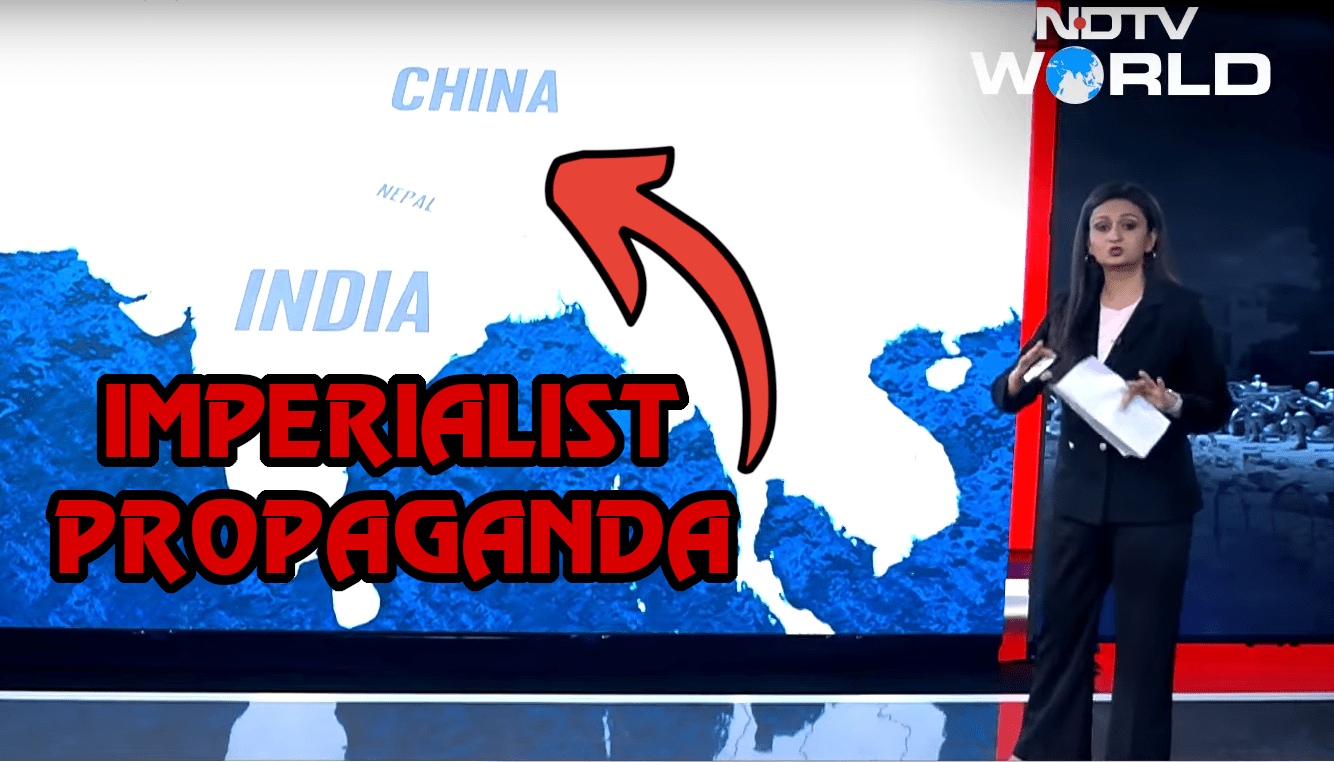
On June 5th, 2025, a video appeared on NDTV’s YouTube channel which, on multiple occasions, granted a vivid insight into the imperialist mindset of the Indian government with regards to Nepal.[1] This video is certainly not one of a kind, but it makes sense to take a closer look into its content to understand the arguments brought forth by Indian imperialists to justify their aggression towards the people of Nepal.
The first outrageous claim is that Nepal wanted to become a province of India in 1975, at the same time that the former kingdom of Sikkim joined India as a state – an event that many call an annexation. NDTV refers to the proposal of King Birendra to have the United Nations declare Nepal an official Zone of Peace – an idea rejected by India. Contrary to NDTV’s claim that this was some sort of effort to join India, the original words of Birendra are clear: “As heirs to a country that has always lived in independence, we wish to see that our freedom and independence shall not be thwarted by the changing flux of time, when understanding is replaced by misunderstanding, when conciliation is replaced by belligerency and war.”[2] There is simply no instance in history in which a sizable majority of Nepalese have ever wanted to become part of India, thus contradicting NDTV’s claim and showing it as nothing but proof of imperialist ambitions.
The video also lies about India’s role in bringing democracy to Nepal between 2005 and 2008. While it is true that India was very much invested in Nepal’s internal affairs, a desire to help Nepal democratize was not among the reasons. Fearing that a Maoist victory in the civil war might spill over to India, the Indian government did not only supply Nepal’s monarchy with arms, but also accepted the erosion of Nepalese democracy. The researcher Sandra Destradi arrives at the following conclusion:
“[E]ven though India put pressure on King Gyanendra […] by officially protesting against his coup and the suppression of fundamental liberties, its use of a combination of hard and soft persuasion in the following months revealed New Delhi’s willingness to support the king as long as […] [he] was considered to be the actor most able to effectively cope with the destabilizing Maoist insurgency, which India feared could spread to its own border states. Accordingly, India’s long-standing support for King Gyanendra […] [was] determined to a large extent by the desire to weaken the Maoists militarily and to maintain a certain stability in the country. Only on one occasion did New Delhi resort to a tool that went beyond mere verbal pressure […]: the suspension of arms supplies to Gyanendra in 2005. However, the continued provision of training to the RNA [Royal Nepal Army] and the discussion about an early resumption of supplies impinged on the credibility of India’s pro-democracy efforts. Besides its desire to stabilize the country and to avoid negative spill-over effects across the open border, India’s main reason for compromising on the principle of support for democracy in Nepal seems to have been, as outlined above, the need to avoid a further increase in external (especially Chinese) influence in Nepal.”[3]
It is especially arrogant of India to praise itself for “democratizing” other countries when their own “democracy” has been degrading for over ten years since current prime minister Narendra Modi first came to power. In 2021, reaching a new low, Freedom House has downgraded India to a “partially free democracy,” and V-Dem has started classifying it as an “electoral autocracy.” Among the chief reasons for this are the gradual erosion of civil rights and the oppression of minorities.[4]

Looking at these blatant lies and NDTV’s audacity to call Nepal “[India’s] backyard,” one can’t help but be reminded of Vladimir Putin’s arguably imperialist propagandist essay, “On the Historical Unity of Russians and Ukrainians,” which was published 7 months before Russia’s 2022 invasion of Ukraine. Keep in mind that NDTV was not only India’s first independent news network, but that as of 2022 it is also majority-owned by the Adani Group which maintains close ties to India’s governing party, the Bharatiya Janata Party (BJP).[5]
The LLCO firmly supports unity and friendship between all oppressed people. Together we can fight our oppressors, capitalism, imperialism, sexism, cast oppression, and ecological disaster. We will not end the fight until the people of South Asia, Africa, Latin America, and the whole world live together in freedom and harmony!
Notes
[1] NDTV. Pro-monarchy Protests Rock Nepal: Nepal On Edge As Battle Of Ideologies Erupts. Retrieved from: https://web.archive.org/web/20250608082412/https://www.youtube.com/watch?v=m3iZB6a8uGc&themeRefresh=1
[2] Isabelle Duquesne (27 July 2011). Nepal: King Birendra’s Zone of Peace discussed. Telegraphnepal. Retrieved from: https://web.archive.org/web/20120604011450/http://www.telegraphnepal.com/national/2011-07-27/nepal:-king-birendras-zone-of-peace-discussed
[3] Sandra Destradi (April 2012). India as a democracy promoter? New Delhi’s involvement in Nepal’s return to democracy. Democratization 19(2), 286-311. Retrieved from: https://www.tandfonline.com/doi/abs/10.1080/13510347.2011.584452
[4] Soutik Biswas (16 March 2021). ‘Electoral autocracy’: The downgrading of India’s democracy. BBC. Retrieved from: https://web.archive.org/web/20250531013757/https://www.bbc.com/news/world-asia-india-56393944
[5] The Economist (9 February 2023). The humbling of Gautam Adani is a test for Indian capitalism: The biggest tycoons need the sternest scrutiny. Retrieved from: https://www.economist.com/leaders/2023/02/09/the-humbling-of-gautam-adani-is-a-test-for-indian-capitalism
 NEW POWER
Leave a comment