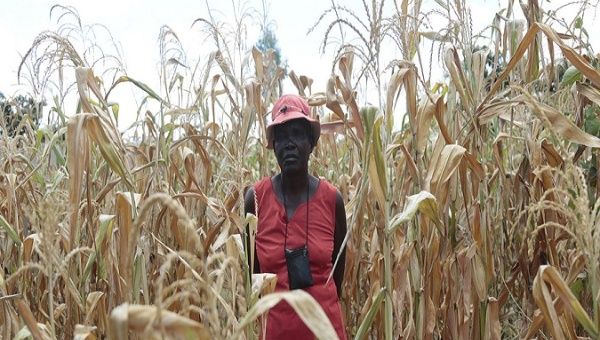
[Under socialism, under the New Power, under Leading Light Communism, such a food crisis would not exist. Food production would be organized scientifically to serve the people, not to serve profit. Under the New Power, diverse food reserves would be stockpiled to avoid such disasters. In addition, populations would not be so dependent on one or two staple foods. Rather, food production would be diversified so that if one crop was hurt, it could be easily replaced. Capitalism is all about profit. People do not matter. -- NP]
Scientist: Cassava disease spread at alarming rate
By MICHELLE FAUL
JOHANNESBURG (AP) — Scientists say a disease destroying entire crops of cassava has spread out of East Africa into the heart of the continent, is attacking plants as far south as Angola and now threatens to move west into Nigeria, the world’s biggest producer of the potato-like root that helps feed 500 million Africans.
“The extremely devastating results are already dramatic today but could be catastrophic tomorrow” if nothing is done to halt the Cassava Brown Streak Disease, or CBSD, scientist Claude Fauquet, co-founder of the Global Cassava Partnership for the 21st Century, told The Associated Press.
Africa, with a burgeoning population and debilitating food shortages, is losing 50 million tons a year of cassava to the disease, he said.
In Uganda, a new strain of the virus identified five years ago is destroying 45 percent of the national crop and up to 80 percent of harvests in some areas, according to a new survey, said Chris Omongo, an entomologist and cassava expert at Uganda’s National Crops Resources Research Institute.
“The new strain looks to us to be much more aggressive,” Omongo said.
Fauquet said one problem is that the virus attacks the tubers underground, so a farmer can husband his crop for up to 18 months and only realize when he goes to dig up the cassava that all his fields are infected.
Omongo has participated in a training video — funded by U.S. aid to the Association for Strengthening Agricultural Research in Eastern and Central Africa — where farmers in north Tanzania are shown digging up cassava and cutting into roots turned black and brown with rot. The farmers say the rotten bits taste bitter and are inedible. They say they spend hours trying to chop away blighted parts.
The disease is spreading too fast to measure its impact, say scientists. A moderate infection with up to 30 percent root damage decreases the market value of cassava tubers drastically, to less than $5 a ton instead of $55, according to a study published last year in the journal Advances in Virology.
“Recent estimates indicate that CBSD causes economic losses of up to $100 million annually to the African farmer and these are probably an underestimate, as the disease has since spread into new areas,” the article said.
Africa produced 150 million tons of the global harvest of 250 million tons last year, with Nigeria alone producing 50 million tons, according to Fauquet.
The cassava disease is endemic along the Indian Ocean coast of East Africa, affecting Kenya, Tanzania and Mozambique. In the past, it had not struck at high altitudes. But recently the disease has been found at up to 1,500 meters (nearly 5,000 feet) above sea level in Uganda, Congo and Tanzania’s lake zones, the article in Advances in Virology reported. The disease also is found in Burundi and Rwanda.
In the past year, Fauquet said, symptoms of the virus have been found as far south as Angola and moving into West Africa. The white fly that acts as a vector for the disease also has been spotted in Cameroon, in central Africa, and in Zambia to the south.
“If the disease makes it to the Congo Basin, which is a big cassava producer, and — really frightening — reaches West Africa and Nigeria, the biggest producer, you can just imagine the impact, the magnitude,” Fauquet said.
This week, scientists are meeting in Bellagio, Rome, to discuss what can be done.
Fauquet said what is needed is the kind of international effort that the West put into creating a virus-free potato after World War II, ending the chance of a disaster such as the Irish potato famine. Similar work has been done on other crops over the past 50 years, including sugar cane and sweet potatoes, he said.
But it has never been done in Africa for many reasons, including the corruption that makes it a difficult environment in which to operate and differences in transport, communications and infrastructure across the continent’s many countries, Fauquet said.
What’s needed is a virus-free cassava seed and the Italian meeting is hosting major funders including the Bill and Melinda Gates Foundation, hoping to convince them of the importance of the project.
Global warming brings a new urgency, said Fauquet and Omongo. Higher temperatures may already be favoring the new strain of the disease, said Omongo. Higher temperatures will increase the number of explosions of insects that transmit viruses, including the white fly, said Fauquet.
“In the next 40 years, starting now, we need to invest in cassava because it could tremendously help Africa and the world but also so that we are more prepared for more diseases,” Fauquet said.
Scientists have called cassava “the Rambo” of food crops, a singular food source expected to become even more productive as the Earth warms, resistant to drought and simply shutting down until rains come. Cassava can also be left in the ground and stored there, providing food security for lean times. Scientists look to cassava as the best bet for African farmers threatened by climate change.
Some 500 million Africans eat cassava, boiled and roasted like potatoes, or pounded into flour to make a stiff porridge-like staple.
Omongo said the good news is that scientists at his research institute have developed a variety of cassava that is more tolerant to brown streak disease, but they cannot produce enough to meet even a quarter of Ugandan farmers’ needs.
“When I say tolerant, I mean that perhaps only 5 percent gets infected instead of an entire field,” he said. “What we need is research to continue so that we can come up with resistant varieties.”
Nigeria’s Finance Minister Ngozi Okonjo-Iweala this week said her country is trying to substitute imported wheat with locally grown cassava, and has so far succeeded in replacing 20 percent of its wheat imports. She said they also are having success encourage people to cook and eat bread made from cassava flour instead of wheat.
May 11, 2013 | Categories: Africa, Food, health, Nigeria | Leave A Comment »
[The imperialists continue to carve up Africa. They do so under the banners of so-called "peace keeping" and "democracy." The imperialists are the reason Africa has the problems of poverty and instability. To invite the imperialists in is allowing the fox into the hen house. -- NP]
French defense minister visits northern Mali
By BABA AHMED
GAO, Mali (AP) — France’s defense minister reaffirmed Friday that his country will keep 1,000 troops in Mali to fight radical Islamic militants even after the arrival later this year of more than 12,000 U.N. peacekeepers.
In a visit to the volatile northeastern city of Gao, Defense Minister Jean-Yves Le Drian addressed reporters a day after the U.N. Security Council authorized the deployment of the peacekeeping force.
“From now on we are in the post-war phase. The U.N. resolution adopted yesterday will allow for the arrival of a force to stabilize the country,” he told reporters. “But France will keep about 1,000 soldiers to carry on with military operations.”
During Le Drian’s visit to Mali, he met with the country’s interim president as well as with Gen. Ibrahim Dahrou Dembele to discuss efforts underway to train the Malian military.
Dembele also highlighted the difficulties that remain in the Kidal region of Mali despite the French military successes.
The area has been patrolled by French and Chadian forces, as local authorities have refused the presence of Malian soldiers whom they accuse of human rights abuses.
Dembele, though, said that secular Tuareg rebels in the area known as the National Movement for the Liberation of Azawad were complicating efforts.
“The problem is right now they are going out into other small villages,” he told the French defense minister.
Some Malians are already questioning how successful the United Nations peacekeeping mission to their country will be given its limited mandate and the volatile mix of armed groups across the north.
The U.N. force is tasked with helping to restore peace after a French-led military operation was launched in January to dislodge radical Islamic fighters who had seized control of the country’s vast north.
However, the U.N. peacekeepers will not be authorized to launch offensive military operations or chase terrorists in the desert, which French forces will continue to do, although France is aiming to downscale its presence in its former colony by year-end.
Daouda Sangare, an entrepreneur in Bamako, questioned how much the peacekeepers would do to protect civilians because of their limited mandate. Other U.N. peacekeepers in Africa have been accused of failing to protect local populations from attack, he said.
“The U.N. forces will only be coming to collect their salaries,” he said. “We have seen the example in Congo, where the M23 rebels entered Goma and the U.N.’s blue helmets were there in the city and did not protect the population. There were deaths and injuries.”
On July 1 the U.N. peacekeepers are supposed to take over from a 6,000-member African-led mission now in Mali, although the deployment date is subject to change depending on security conditions.
The transformation into a U.N.-led mission will be a positive step because it will have considerable financial backing, said Ousmane Diarra, a Bamako-based politician.
“Until now, the African forces that have been in Mali have been financed by their countries,” he said. “That was a worry for us because it was not clear that the African countries could continue to finance their military mission in Mali.”
Mali fell into turmoil after a March 2012 coup created a security vacuum that allowed secular Tuareg rebels to take over the country’s north as a new homeland. Months later, the rebels were kicked out by Islamic jihadists who carried out public executions, amputations and whippings.
When the Islamists started moving into government-controlled areas in the south, France launched a military offensive on Jan. 11 to oust them. The fighters, many linked to al-Qaida, fled the major towns in the north but many went into hiding in the desert and continue to carry out attacks including suicide bombings.
“We know it’s going to be a fairly volatile environment and there will certainly be some attacks against peacekeepers where they will have to defend themselves,” U.N. peacekeeping chief Herve Ladsous told reporters on Thursday.
France is gradually reducing its presence in Mali — currently just under 4,000 troops — and French officials said they expect to have roughly 1,000 there by year-end. Some 750 of those will be devoted to fighting the insurgent groups, officials said.
The U.N. force will also operate alongside a European Union mission that is providing military training to the ill-equipped Malian army, which was left in disarray by the March 2012 coup.
___
Associated Press writers Edith M. Lederer at the United Nations and Jamey Keaten in Paris contributed to this report.
April 26, 2013 | Categories: Africa, France, Islam, Mali | Leave A Comment »
[Although Mugabe is no revolutionary, he is an anti-imperialist, a nationalist. His regime is one of the patriotic bourgeoisie. Leading Lights and anti-imperialists support Zimbabwe's attempts to resist Western domination. --NP]
Zimbabwe president: No interference in new polls
By ANGUS SHAW
HARARE, Zimbabwe (AP) — At Zimbabwe’s independence celebrations, President Robert Mugabe said Thursday his nation won’t accept outside interference in crucial elections later this year and urged Zimbabweans to vote peacefully to confound foreign critics.
In an unusually short and good natured address, Mugabe told a capacity crowd of 60,000 at Harare’s main sports stadium that Zimbabweans have an obligation to “uphold and promote peace before, during and after” upcoming polls that would end a shaky coalition with the former opposition.
“Go and vote your own way. No one should force you to vote for me,” Mugabe said, speaking in the local Shona language during celebrations marking 33 years of independence from colonial rule.
Mugabe said he welcomes recent efforts by Western nations to reopen dialogue with Zimbabwe after years of isolation to protest political violence, rights abuses and alleged vote rigging. But Western leaders must let the nation’s people “determine our own destiny” and defend the country’s independence without interference, he said.
“Interference in our affairs will never be accepted,” he said, while calling on Zimbabweans to conduct themselves honorably during the elections, which could be held anywhere from late June to September.
“We must reflect on the need for full commitment to Zimbabwe and gear ourselves toward holding peaceful elections this year. Please don’t shame us. The world is watching,” Mugabe said.
In past electioneering, Mugabe has been widely accused of fanning violence and intimidation against his political opponents by strident remarks that they mostly did not contribute to the fight for independence and were puppets of his Western critics. He frequently brandished his party’s clenched fist salute and once famously declared: “See this fist, it can smash your face.”
Mugabe insists he will not allow Western election observer delegations to monitor the new polls. Only regional African monitors will be accredited to oversee voting. In 2002, Mugabe expelled a European Union election observer mission after it recorded violence and irregularities in that year’s national poll.
In Thursday’s speech, he said Zimbabweans shunned “hate and violence” in a referendum on a new constitution in March. In that ballot, 95 percent of voters accepted the constitution that calls for strengthened human rights, a return to the rule of law and an end to impunity enjoyed by Mugabe militants since the often violent seizures of thousands of white owned farms began in 2000.
Western diplomats who have stayed away from several state functions in the past after Mugabe launched stinging attacks on their nations were at Thursday’s celebrations. The festivities in this former British colony featured military parades and martial arts displays, local music bands and a soccer match.
Mugabe said foreign critics now “grudgingly” acknowledge the path the nation has chosen for itself.
After the last violent and disputed elections in 2008, regional leaders forged a coalition between Mugabe and Prime Minister Morgan Tsvangirai, the former opposition leader.
Mugabe has called for new polls by the end of June but Tsvangirai says that’s too soon and more time is needed to put in place democratic reforms called for in the new constitution and demanded by regional mediators. He has proposed mid-September as the earliest possible time for the watershed vote.
——
Associated Press reporter Gillian Gotora in Harare contributed to this report
April 22, 2013 | Categories: Africa, Zimbabwe | Leave A Comment »

[The poor of the Third World should not look to Madonna or any other liberal do-gooder to save them. The poor of the Third World do not need so-called NGOs. They do not need charity. They need liberation. They need political power. They need the power to build their own schools. If Madonna were serious about aiding the Third World poor, she would donate her millions to the Leading Light--NP]
Madonna opens Malawi school project
By RAPHAEL TENTHANI
(AP)
KASUNGU, Malawi (AP) — Schoolchildren joined by hundreds of villagers danced around pop diva Madonna and serenaded her with praise songs on Tuesday as she inspected school blocks she helped to construct in the central Kasungu district.
“Zikomo! (Thank you!)” said the singer as the Malawians people danced around her at Nkoko Primary School where she worked with the non-profit organization, BuildOn, to build classrooms.
Madonna initially planned to build a $15 million 500-bed Raising Malawi Academy for girls, before changing plans to help fund several community schools to benefit more Malawians. She arrived in Malawi Monday to tour the 10 school wings she has helped to build.
“I love Malawi, I am committed to help end poverty here,” she said.
Madonna is the “biggest global philanthropist” Malawi has ever had, said Trevor Neilson, president of the Global Philanthropy Group that is managing the pop star’s projects in Malawi. She is exploring more projects she can work on in Malawi, said Neilson.
Madonna’s efforts have provided new classrooms for more than 4, 000 children who previously were learning under trees.
“Madonna is happy that the communities are appreciating her efforts,” he said.
Madonna has been joined on her tour by her two adopted Malawian children, David Banda and Mercy James, both now eight.
April 6, 2013 | Categories: Africa, culture, Malawi, pop culture | 1 Comment »

[The United States is still using Kony as its bogeyman in order to extend its presence, both militarily and economically, into Africa. The United States and other imperialists have killed far more, done more damage, than Kony. This is yet another imperialist smokescreen. Kony 2012 was a psywar campaign aimed at generating support for imperialist wars in Africa under the banner of humanitarianism. The campaign was mostly aimed at "liberal do gooders." --NP]
US to seek ways to continue helping hunt for Kony
By JASON STRAZIUSO
(AP)
NAIROBI, Kenya (AP) — The United States is looking for ways to ensure the hunt for wanted warlord Joseph Kony continues in Central African Republic despite a change in leadership in the country that has forced the search to be suspended, a State Department official said Thursday.
The U.S. announced a new $5 million reward for information leading to the arrest of Kony, the leader of the Lord’s Resistance Army, a small but brutal band of warriors who abduct children and adults as fighters and sexual slaves.
There are 100 U.S. special forces helping advise African forces across Central African Republic, South Sudan, Congo and Uganda. But rebels in CAR deposed the president and took the capital, Bangui, more than a week ago, and African and U.S. efforts to hunt Kony there have since been put on pause.
Stephen J. Rapp, an ambassador-at-large for the State Department’s Office of Global Criminal Justice, sounded optimistic that an agreement could be reached to allow the hunt to continue. Rapp said the rebels in the new government also don’t want to see Kony in their country and are looking to eliminate the threat Kony brings “within the next six months.”
“So I think we’re going to have the potential for support for operations there,” he said in a telephone conference with reporters. “Operations there have been paused. People there haven’t been withdrawn. Work will go on to make sure that operations can go on. It’s in the interest of the CAR and in the interest of all the people in the region.”
Because the rebels in Central African Republic took power by force, kicking the president out of the capital, the U.S. has restrictions on the cooperation and activities it can carry out with the new leadership. The African Union has voted not to recognize the rebels as the leaders of the country.
Rapp suggested that maybe Ugandan and U.S. forces in CAR will be able to work with local police, “but we’ll see. It’s all the more important that negotiations … succeed. On this issue I think there’s broad common ground. Everyone wants to see the end of the threat of Joseph Kony.”
Along with the reward for Kony, the Obama administration announced up to $5 million in rewards for two of Kony’s top aides and for a Rwandan rebel leader suspected of crimes against humanity.
The International Criminal Court issued an arrest warrant for Kony in 2005 for his brutal campaign that originated in Uganda in the 1980s. He became better known in the U.S. after the release in March 2012 of a video called “Kony 2012″ by the charity Invisible Children. The video became an internet sensation, being viewed by more than 100 million people.
The rewards are being offered by the State Department under a provision in the War Crimes Rewards Program authored by Secretary of State John Kerry when he was a senator and signed into law by President Barack Obama in January.
Rapp said the reward could discourage others from engaging in brutal acts. He said they remind wanted criminals that “the world will continue to look for you.”
April 6, 2013 | Categories: Africa, Central African Republic, Congo, Kony, South Sudan, Uganda, US | Leave A Comment »

[The imperialists are using the cover of humanitarian intervention in order to tighten their grip on Africa. They seek to turn a military operation into a permanent presence on the continent. This is sick considering that France was one of the bloodiest of the imperialist countries in its dealings with Africa. Asking France for "help" is inviting the fox into the hen house. The key to liberation is the unity of the poor of the Third World and their allies under the leadership of the most advanced revolutionary science, Leading Light Communism. -- NP]
France wants to keep 1,000 soldiers in Mali permanently
By Adama Diarra and John Irish
(Reuters)
BAMAKO/PARIS – France has proposed keeping a permanent force of 1,000 French troops in Mali to fight armed Islamist militants, Foreign Minister Laurent Fabius said on Friday.
Fabius, on a visit to Bamako, said France was pushing ahead with plans to reduce its 4,000-strong military presence from the end of this month but planned to keep a combat force in Mali to support a future U.N. peacekeeping mission.
U.N. Secretary-General Ban Ki-moon called last week for the deployment of a U.N. mission of 11,200 troops and 1,440 police in Mali once major combat ends.
This would include thousands of African troops already in Mali in support of France’s three-month military campaign, which has swept Islamist rebels out of the towns of northern Mali and into remote desert and mountain hideaways.
Ban’s plan also referred to a parallel force to tackle al Qaeda-linked Islamist extremists directly, which diplomats had said would likely be French. Paris has repeatedly warned that the Islamist enclave in north Mali posed a threat to the West and pledged to entirely eradicate it.
“France has proposed, to the United Nations and to the Malian government, a French support force of 1,000 men which would be permanent, based in Mali, and equipped to fight terrorism,” Fabius said before leaving Bamako after a one-day visit.
A diplomatic source in Paris said France hoped to have the peacekeeping force approved by the Security Council within three weeks, and to have it deployed by the end of June or early July in time for scheduled presidential elections.
A clause in the U.N. resolution will allow Ban to request the rapid intervention of France’s 1,000 troops, which would be deployed under a bilateral deal with Mali, the source said.
Despite widespread concerns over continuing Islamist attacks in northern Mali and the lack of an effective government presence in many areas, France is pressing its former colony to quickly organise nationwide elections to complete a democratic transition after a March 2012 coup.
“It is best that elections are held,” Fabius said. “Our Malian partners say they want that and it is possible. The target is July and everything is being done to meet that deadline.”
CALL FOR TUAREGS TO DISARM
Fabius called directly on the MNLA Tuareg separatist rebels, who have assisted French forces in northern Mali after Islamists fled the Tuareg stronghold of Kidal, to lay down their arms and take part in the political process.
Tuareg fighters have helped France and their Chadian allies to track down pockets of militants near Kidal. The success of an MNLA uprising early last year sparked March’s military coup but the northern rebellion was soon hijacked by Islamist groups.
“All groups including the MNLA must agree to be confined to barracks and disarm,” Fabius said, after meeting with Mali’s interim president Dioncounda Traore. “We wish to see the official reopening of negotiations.”
Many observers have questioned plans for a swift reduction of France’s 4,000 troops in light of the continuing Islamist insurgency and a freeze in peace talks with Tuareg rebels.
Islamist insurgents attacked the northern city of Timbuktu for the second time in a fortnight last week, promising to “open the gates of hell” when the French leave.
Mariam Diallo, an analyst with the Washington-based National Democratic Institute, said the July date for the elections was not feasible and could lead to further problems.
“Everything is in chaos and trying rush the elections could be problematic,” she said, adding Mali should be given time to resolve the question of displaced people and the electoral register.
Mali’s Foreign Minister Tieman Coulibaly said the gold- and cotton-producing nation was capable of meeting the timetable.
“Refugees and those displaced internally by the crisis could vote in their camps. It is technically possible,” he said.
April 6, 2013 | Categories: Africa, Europe, France, Mali | Leave A Comment »
[The new scramble for Africa is on.. oh wait.. the imperialist scramble never really ended. The United States is getting in on the action. --NP]
US Senators McCain, Whitehouse visit Mali
By BABA AHMED
(AP)
BAMAKO, Mali (AP) — United States Sens. John McCain and Sheldon Whitehouse arrived in Mali’s capital, Bamako, Tuesday for a two-day visit to assess the country’s battle against Islamic extremist rebels in the north.
The Arizona Republican and the Rhode Island Democrat met with Mali’s acting President Dioncounda Traore and interim Prime Minister Diango Cissoko Tuesday.
The senators “arrived in Bamako to take in the situation on the ground to better understand the present challenges so that they can foster the most appropriate contribution from America,” said a statement issued by the United States embassy in Bamako.
Mali’s northern half was overrun by rebels from al-Qaida in the Islamic Maghreb last year. The senators are touring the capital as a French-led military intervention to expel the extremists enters its third month.
McCain said the U.S. will continue to provide humanitarian aid and military assistance, including equipment, training and technology, to the French campaign to kick the al-Qaida-allied rebels out of Mali.
Since the French forces intervened in Mali in January, U.S. drones have provided intelligence to help their battle, including information to find the extremists holding seven French hostages. The U.S. will use all means at its disposal to track the kidnappers, said McCain.
Sen. Whitehouse said the U.S. wants to encourage successful elections in Mali, which would allow Washington to increase direct assistance to Mali.
The senators also discussed the problem of drug trafficking with Traore. Since 2005, Mali has been a transit point for drugs and this illicit business is corrupting the country’s democracy, said McCain.
April 6, 2013 | Categories: Africa, Islam, Mali, US | Leave A Comment »
[This is yet another example to imperialist expansion into Africa through AFRICOM. -- NP]
US to invest $1.2 million for Ghana police academy
(AP)
ANYINASE, Ghana (AP) — The United States embassy in Ghana’s capital says the U.S. is investing over $1.2 million to construct a training center for the marine unit of the Ghana police.
U.S. and Ghana officials broke ground for the National Marine Police Training Academy Tuesday in the city of Anyinase, on Ghana’s southwest coast.
The U.S. embassy statement says the U.S. Africa Command, or AFRICOM, coordinated the academy with the U.S. Force Protection Detachment in Ghana and the Ghana police service to help law enforcement officials hone their skills to protect Ghana’s coastline.
It says the unit will target illicit activities at sea, such as piracy, illegal arms, narcotics and human trafficking.
The AFRICOM Counternarcotics and Law Enforcement Division has backed other similar projects throughout Ghana and Africa.
March 29, 2013 | Categories: Africa, Ghana, police, US | Leave A Comment »

[First Worldist feminism advances or seeks to advance the position of First World women (Whites, Blacks, Gay, Straight, Transgendered, etc.) at the expense of Third World peoples. Below is a good example. Once a "boy's club," offices like the CIA's National Clandestine Service, can be hailed as oh-so-progressive because it is now headed by a glass-ceiling-breaking woman. Here are blatant examples of First World women who are advancing within the oh-so-progressive liberal empire on empire's terms. These women can be seen as a microcosm of First World women, and peoples, as a whole. First World people have historically had their life options expanded at the expense of continued restriction of life options of Third World peoples, including Third World women and children. The carnival of First World privilege is only made possible by the creation and maintenance of semi-feudalism and other kinds of extreme patriarchal oppression across much of the Third World. Women and children in the Third World suffer some of the most reactionary forms of patriarchal oppression in the world because imperialism forges an alliance between imperial capitalist, comprador capitalist in the Third World, and the remnants of feudalism in the Third World. First World men and First World women are afforded more possibilities in life because Third World peoples, including women and children, are held in terrible bondage. Third World opportunities are restricted whereas First World opportunities, including the opportunity to head important offices in the security state or, let's say, the opportunity to head-up a politically-correct eco-village or a punk band, etc. are increased. Just because everything is tainted in the First World does not mean that some paths are not better than others, obviously. Those Leading Lights in the First World must not give into individualism, anarchism, nihilism, hipsterism, etc. Follow the path of the Leading Light to live a life in service to the people, not a life riding on the backs of the people. Women and children in the Third World are reduced to virtual machines or slaves to ensure that imperial prosperity, fun, diversity, etc. is maintained. In the heart of empire, the trend is toward a liberal, social-democratic, feel-good carnival at the expense of the Third World. In the more remote pockets or edges of empire, the trend is more varied. In places like Greece, more on the edge of empire, for example, more traditional fascism -- with its emphasis on restricting women to their traditional role -- has gained strength. In other words, the contradiction between women may play out differently there. In any case, it is important to distinguish real feminism, proletarian fminism, Leading Light feminism from First Worldist feminism. While it may be important to root up and eliminate pockets of backward thinking within our communities even in the "belly of the beast," etc., we must always remember that First World women and First Worldist feminism, as a whole, are not going to be on our side. We must always remember the question of first importance. One of our great Leading Lights of the past, Chairman Mao asked: Who are our enemies? Who are our fiends? We must always seek to fight global patriarchy. We must never accept so-called "liberation" on empire's terms. Feminism that is not thoroughly anti-imperialist is not real feminism. Real feminism opposes First Worldism as a whole. Our sisters are the vast majority of women in the Third World and their allies, especially their Leading Light allies in both the Third and First Worlds. Let empire brag about their women protectors. Let us bring forward our Leading Lights, women and youth to rid the world of imperialism. Let us bring forward teachers of the future, people's warriors, guardians of the Earth, Leading Lights. -- NP]

The Woman Protecting America That Nobody Knows
By Elise Solé, Shine Staff
(Shine)
An unnamed woman has been appointed acting head of the CIA’s National Clandestine Service. According to a Washington Post article, this is the first time a woman has ever led the branch that oversees the agency’s covert operations. The woman, who remains undercover, was placed in the top position shortly before John Brennan was sworn in as CIA Director on March 8, but the news only broke on Wednesday. The timing coincides with another first for women in government. Julia Pierson was named director of the Secret Service on Tuesday.
More on Yahoo! Shine: The Most Inspirational Stories of 2012
The woman’s identity is kept secret but according to The Daily Mail, she’s believed to be in her 50s. The Washington Post calls her a “veteran officer with broad support inside the agency” but also reveals her controversial past as the officer who helped run the CIA’s detention and interrogation program after the Sept. 11, 2001 attacks. In 2005, she and her then-boss signed off on the decision to destroy videotapes of prisoners being subjected to treatment critics have called torture. (The destruction was investigated by the Justice Department but no charges were filed.) Both these incidents must be considered in order for her to be given the gig full time.
A former senior U.S. intelligence official who anonymously spoke to “The Washington Post” says she “is highly experienced, smart and capable,” and giving her the job permanently “would be a home run from a diversity standpoint.” However she was “also heavily involved in the interrogation program at the beginning and for the first couple of years.”
More on Yahoo! Petraeus making first speech since leaving CIA
Because of her past, says the senior U.S. intelligence official, CIA Director John A. Brennan “is obviously hesitating” at making her role permanent. To help him make the decision, he’s having three former CIA officials evaluate the candidates, a selection process that’s never been used before, said the official.
Promoting women like her and Pierson to senior government roles is a big deal since spy and law enforcement agencies have traditionally been “boy’s clubs”, known to resist the gender diversity that’s occurred more rapidly in other parts of government. The newly appointed women are real-life role models for those who have only seldom had such female figures to look to in Hollywood movies and television shows. Characters such as Sydney Bristow, a CIA agent played by Jennifer Garner in “Alias” (2001), Claire Danes’ character CIA spy Carrie Mathison on “Homeland” (2011), CIA officer Evelyn Salt played by Angelina Jolie in “Salt” (2010) and Maya, a young CIA officer in director Kathryn Bigelow’s 2012 film “Zero Dark Thirty” are rarities in a sea of roles occupied by the Denzel Washington/Matt Damon/George Clooney’s of the world.
These fictitious female CIA officials are often created with the help of a CIA government agency called the Entertainment Liaison Office which collaborates with the film industry on how the CIA is portrayed in the media. According to their website their role is to “give greater authenticity to scripts, stories, and other products in development. That can mean answering questions, debunking myths, or arranging visits to the CIA to meet the people who know intelligence — its past, present, and future. In some cases, we permit filming on our headquarters compound.”
Perhaps the promotion of Pierson and this unnamed CIA official will start to become the norm, both in Hollywood and in real life.
March 28, 2013 | Categories: Africa, art, Asia, CIA, civil liberties, culture, economy, environment, fascism, fashion, Gender, globalization, history, Latin America, Middle East, North America, occupy movement, police, pop culture, psywar, US | Leave A Comment »

S Africa police boss endorses officers in killings
By NQOBILE NTSHANGASE
(AP)
MARIKANA, South Africa (AP) — South Africa’s police chief said Tuesday she stands by her statement praising officers involved in the shooting massacre of 34 striking miners and insisting they were “just doing your work.”
Evidence before the judicial commission questioning her Tuesday has indicated some miners were shot in the back as they tried to flee and others were killed when they already were wounded and no threat.
Gen. Riah Phiyega said “I stand by statement.” She repeated that after a commissioner asked her if she might feel differently given other evidence that has come to light.
Police said they opened fire after striking miners attacked them. No police were hurt in the Aug. 16 incident at the Lonmin platinum mine in Marikana, northwest of Johannesburg, that shocked the nation with its echoes of police brutality under apartheid. It was the worst state violence since that system of white minority rule ended in 1994.
Phiyega, who had been newly appointed, stuck to her story even after evidence leader Mbuyiseli Madlanga read testimony from a police officer who said that he was searching for other suspects when he heard a gunshot from behind, where he had left a group of wounded miners. He said he turned to see a constable putting a revolver back in its holster and, when he asked what was going on, the constable said: “They deserve to die.”
Photographic evidence presented to the commission in November showed police may have altered the scene of the killings and planted weapons after they shot 112 miners, killing 34.
Photographs taken by police at night show more weapons by the dead bodies than there were in news photographs taken immediately after the violence.
Video evidence shown to the commission has also indicated that some of the slain miners were handcuffed.
Thousands of miners had been striking for six weeks in Marikana to demand more money. Twelve people had been killed before Aug. 16, including two police officers, in violence blamed on rivalry between two unions, including the government-allied National Union of Mineworkers. The day after the shootings, Phiyega told a gathering of officers, “I want to thank you once more for doing what you did … All we did was our job, and to do it in the manner in which you were trained. … Don’t feel you are being persecuted as police — you were doing your work.”
March 21, 2013 | Categories: Africa, ANC, civil liberties, police, protests, South Africa, workers struggle | Leave A Comment »
[Capitalism is irrational from the standpoint of balancing ecological and human needs. Instead, communities are not planned in harmony with the natural world nor are poor communities protected from such disasters. This irrationality is part of what Karl Marx called the anarchy of the capitalist mode of production. The reason that poor people lose their lives in such disasters is because capitalism does not value them enough to create the proper infrastructure to prevent such problems. The reality is that such disasters are the result of hundreds of years of neglect inflicted by the wealthy, the feudalists, the capitalists, the imperialists, the First World, against the proletarian and the poor classes, against the Third World. The reality is that natural disasters are as much man-made as natural. Such disasters are yet another crime by the rich against the poor. The reformists, global institutions, the reactionary state, the capitalists refuse to place the blame on capitalism itself. Instead they repeat the same old lies. They say that the system can be fixed. The reality is that they will never fix their system because they are the system. The nature of capitalism is to serve the wealthy, not the poor. From their point of view, from the standpoint of the wealthy, capitalism is working fine even if poor peoples are slaughtered. -- Leading Light]
Global warming may have fueled Somali drought
By JASON STRAZIUSO
(AP)
NAIROBI, Kenya — Global warming may have contributed to low rain levels in Somalia in 2011 where tens of thousands died in a famine, research by British climate scientists suggests.
Scientists with Britain’s weather service studied weather patterns in East Africa in 2010 and 2011 and found that yearly precipitation known as the short rains failed in late 2010 because of the natural effects of the weather pattern La Nina.
But the lack of the long rains in early 2011 was an effect of “the systematic warming due to influence on greenhouse gas concentrations,” said Peter Stott of Britain’s Met Office, speaking to The Associated Press in a phone interview.
The British government estimates that between 50,000 and 100,000 people died from the famine. But the new research doesn’t mean global warming directly caused those deaths.
Ethiopia and Kenya were also affected by the lack of rains in 2011, but aid agencies were able to work more easily in those countries than in war-ravaged Somalia, where the al-Qaida-linked Islamic extremist group al-Shabab refused to allow food aid into the wide areas under its control.
The peer reviewed study will appear in Geophysical Research Letters, a journal of the American Geophysical Union.
Senait Gebregziabher, the Somalia country director for the aid group Oxfam, said climate change is increasing humanitarian needs.
“In the coming decades, unless urgent action is taken to slash greenhouse gas emissions, temperatures in East Africa will continue to rise and rainfall patterns will change. This will create major problems for food production and availability,” Gebregziabher said.
Stott said that the evidence is “very strong” that the planet is warming due to an increase in greenhouse gases. He noted that the study indicates that both natural causes — La Nina and the short rains — and man-made causes contributed to Somalia’s drought.
The Met Office’s computer modeling study found that between 24 percent and 99 percent of the cause of the failure of the 2011 rains can be attributed to the presence of man-made greenhouse gases, Stott said.
Global warming is caused by the burning of fossil fuels — coal, oil and natural gas — which sends heat-trapping gases, such as carbon dioxide, into the air, changing the climate, scientists say.
Ahmed Awale works for the non-profit group Candlelight, which is dedicated to improving conservation and the environment. He believes Somalia’s climate has been changing for many decades, with rainfall patterns becoming more erratic.
“If you miss one of the two rainy seasons we have a very severe drought. The other indicator is that there is a rise in temperature,” he said, adding later: “This all negatively impacts the livelihood of the people. Most of Somalis depend mostly on pastoral production.”
March 16, 2013 | Categories: Africa, environment, Somalia | Leave A Comment »
[The Western media beat the drums of war against Gaddafi. Now, it is reported that human rights are even worse in Libya since the Western-backed invasion of Libya. There are horrific abuses against black Africans and minorities in Libya.
A weak, divided Libya is easier to exploit. -- CP]
Christians say they were tortured in Libya
By MAGGIE MICHAEL
(AP)
CAIRO (AP) — Dozens of Coptic Christians were tortured inside a detention center run by a powerful militia in eastern Libya, two of the recently released detainees told The Associated Press on Friday amid a wave of assaults targeting Christians in Benghazi and the latest instance of alleged abuse by Libyan security forces.
The two, among an estimated 50 Egyptian Christians who have been detained in Libya on suspicion of proselytizing, told of being rounded up in a market by gunmen who checked their right wrists for tattoos of crosses.
“They first checked our wrists searching for the crosses and if they found them, we (had to) get into their cars,” said 26-year-old Amgad Zaki from the southern city of Samalout in Minya province, 220 kilometers (135 miles) south of Cairo.
Zaki said a group of men — some in uniform and some in civilian clothes — rounded up Egyptians selling clothes in a market called el-Jareed in Benghazi on Feb. 26. He and other Christians climbed into SUVs that he said carried the sign of Libya Shield One, one of the most powerful militias in Benghazi that is under the command of Islamist and ex-rebel Wassam Bin Hemad.
“They shaved our heads. They threatened to sever our heads in implementation of Islamic Shariah (law) while showing us swords,” said Zaki, who was interviewed on the telephone from his home after returning to Egypt earlier this month.
“They dealt with us in a very brutal way, including forcing us to insult our Pope Shenouda,” Zaki said, referring to the former Coptic pontiff who died last year.
He said that during four days of detention they were flogged, forced to take off their clothes in cold weather and stand at 3 a.m. outdoors on floor covered with stones.
“I was taken to clean a bathroom, and the man pushed my head inside the toilet and sat on me,” he said. “I was dying every day, and at one point I thought death is better than this.”
Militias have been targeting Christians, women, journalists, refugees and those considered former loyalists of Moammar Gadhafi, who was toppled and killed in Libya’s 2011 civil war. The state relies on the militias to serve as security forces since Libya’s police and military remain in shambles.
Egypt’s foreign ministry said that its embassy in Libya was investigating the allegations of torture.
The militia that held the group claimed it treated the Coptic Christian detainees well.
However, Atef Habib, 34-year-old vendor who is also from Minya province, also alleged mistreatment in the detention center.
He recalled how a Coptic Christian priest was beaten up and his head and mustache were shaved by the captors. Habib said that an aide to the priest also was beaten. “His face was blackened and bleeding from beating,” Habib said.
Fathi Ubaidi, one of the top commanders of Libya Shield, denied abusing the Coptic Christians. He said in a phone interview that the Egyptians were treated “very well” and “if there is any rights organization who would like to talk to them, they are more than welcome.”
The family of one Coptic Christian who also was arrested in Benghazi for allegedly spreading Christianity said he was tortured to death in a detention center in the Libyan capital, Tripoli. His wife, Ragaa Abdallah, and his relatives blame his death on torture, but the Egyptian Foreign Ministry said that the man, Ezzat Atallah, who suffered from diabetes and a heart ailment, likely died of natural causes.
Earlier this week in Cairo, demonstrators burned a flag belonging to the Libyan Embassy to protest Atallah’s death.
Hundreds of thousands of Egyptians are working construction and trade jobs in Libya, a nation of 6.5 Muslims with no significant religious minority. Hundreds are believed to have killed in crossfire during the war and many others have lost their jobs.
Benghazi witnessed a series of assassinations of top security and military officials and diplomats’ convoys have come under fire, prompting Western countries to urge their citizens to leave. On Sept. 11, U.S. Ambassador to Libya Chris Stevens was killed along with three other Americans during an assault on the U.S. mission in Benghazi. An Islamic militia group named Ansar al-Shariah was blamed for the attack.
The first word that dozens of Egyptian Christians had been detained spread after a video clip surfaced last month showing a Libyan militiaman in uniform holding a group of Christian Egyptians. The militiaman said that the detainees, whose heads were shaved, were among nearly 100 Coptic Egyptians being held for allegedly spreading Christianity in Libya.
The video showed Bibles and Christian books next to the detainees. It surfaced only few days after authorities announced the arrest of an Egyptian, South Korean, South African and Swede, who had an American passport, for allegedly spreading Christianity. The Libyan police chief behind that case, Abdel-Salam el-Barghathi, said that the two cases are separate.
The story of the Coptic Christian detainees come at the same time that the Libyan parliament has halted its sessions after being attacked by militiamen. The head of the parliament escaped an assassination attempt during last week’s attack.
Moreover, two days ago, Hassan al-Amin, the head of the human rights committee of the parliament, fled to London in self-exile after receiving death threats to him and his family.
He told a private-owned Libyan network Al-Assima — which was raided by unidentified gunmen more than a week ago — that he was resigning from parliament. Al-Amin is a longtime opposition figure who has been on the run from Gadhafi’s regime for nearly 30 years. His resignation came after speaking against militias and warning of their human rights abuses.
In an audio clip that was widely circulated on social media, al-Amin said he had seen abuses taking place in prisons that are “much worse than those that took place in the days of Gadhafi.”
March 16, 2013 | Categories: Africa, Christianity, civil liberties, Islam, Libya, Middle East, NATO | Leave A Comment »

[The West supports the crushing of dissent in Mali. So much for so-called "democracy." -- New Power]
Mali media outlets go silent over editor’s arrest
By BABA AHMED
(AP)
BAMAKO, Mali (AP) — The airwaves in Mali’s capital fell silent on Tuesday and newspapers didn’t print a morning edition in protest over the arrest last week of an editor who published an open letter challenging the salary of the country’s coup leader.
Boukary Daou, editor-in-chief of The Republican newspaper, was taken away by agents from Mali’s intelligence service on March 6, soon after his newspaper published a letter from an army officer denouncing Capt. Amadou Haya Sanogo’s recently-decreed salary of $8,000 per month, an incredibly high salary in the impoverished country. The letter argues that the salary — as much as 26 times what Sanogo earned before last year’s coup — is in fact an incentive for future coups.
Sanogo seized power a year ago last March. Faced with international sanctions, he was forced to relinquish control just weeks later, but succeeded in negotiating a golden parachute for himself, including the salary of an ex-head of state. Despite officially stepping down, country watchers say Sanogo remains the power behind the throne, as Daou’s arrest seven days ago underscores.
The media strike began on Tuesday and “will continue until Boukary Daou is freed,” according to a statement from the country’s press association.
President Dioncounda Traore defended the decision to arrest Daou and said that if he is innocent, he will be freed. Speaking to reporters during a stop in the capital of neighboring Senegal, Traore said the letter published in The Republican was subversive, and aimed to demoralize the nation’s troops at a time of war.
“Mali is in a state of emergency. We all need to remember this. We are in a state of war, and we cannot allow this kind of thing,” he said. “If he is guilty, he will need to answer to the courts. If he is not, there’s no reason he’ll be kept in prison,” he added.
Kassim Traore, the president of the Young Journalists’ Organization of Mali said that Daou has refused to disclose the identity of the officer, who penned the letter under the name Capt. Toure.
“The security agents demanded that Daou give the name of his source and Daou refused, which is his duty as a journalist,” said Traore. “It’s because he would not disclose the name of his source that they are still detaining him, which is why the leaders of the Malian press have organized this No Press Day in order to free our colleague,” he said.
In the chaos that followed Sanogo’s coup last year, a mixture of rebel groups allied with al-Qaida occupied Mali’s northern half, plunging the country and the region into crisis. Since January, French troops, helped by Malian soldiers, have been methodically clearing the north. The letter published in The Republican threatened that if Sanogo’s salary is not reduced, soldiers deployed in Mali’s north will refuse to fight. The average salary of a rank-and-file soldier is just $100 per month, 80 times less than what Sanogo is now earning.
The incendiary letter began: “Mr. President, we have learned that while we are dying in the great desert (in northern Mali), Capt. Sanogo, in return for leading a coup that plunged the country into the current situation, enjoys a salary of 4 million francs ($8,000). And the others in his group, in his clan, who are refusing to come fight are enjoying the same treatment,” wrote Capt. Toure. “If this decision (to accord him this salary) is not reversed within the next two weeks, we will cease … fighting.”
A communique read on state television late Monday said Mali’s military had not been able to find an officer of that rank with that name, and urged the press “to be more vigilant in the face of the obscure endeavors (of those) seeking to compromise the unity and discipline of our troops in the field.” The communique added that “the investigation is in progress by the relevant authorities in order to identify the real author of this fake letter whose aim was to destabilize our army.”
___
Associated Press writers Babacar Dione and Rukmini Callimachi contributed to this report from Dakar, Senegal.
March 13, 2013 | Categories: Africa, Europe, France, Islam, Mali | Leave A Comment »
Image

February 6, 2013 | Categories: Africa, France, Mali | Leave A Comment »
[Imperialists continue their new scramble for Africa. --NP]
French army continues strikes in northern Mali
By THOMAS ADAMSON
(AP)
PARIS — France’s Defense Ministry has said the country’s military forces continued aerial strikes in northern Mali, just a few hours after a visit to the country by President Francois Hollande.
French troops bombarded Islamist sites in Kidal and Tessalit in northern Mali overnight Saturday into Sunday, according to a defense official Sunday who spoke on condition of anonymity because he wasn’t authorized to be quoted by the media.
The official says “(the strikes) were targeting logistical arms and fuel depots near the Algerian border.” He could not confirm that the latest attacks also targeted armed Islamist training camps.
February 4, 2013 | Categories: Africa, France, Islam, Mali | Leave A Comment »

[The imperialists have waged a war against Africa for hundreds of years. Today the imperialists foster chaos in Africa in order to intervene and extend their control. We must oppose imperialism at every turn. Hands of Mali! -- NP]
French airstrikes jolt Islamists in Malian town
By KRISTA LARSON and BABA AHMED
(AP)
BAMAKO, Mali — Backed by French air strikes, Malian forces appeared close to recapturing a key central town in Mali where bands of al-Qaida-linked fighters had holed up, France’s defense minister said Sunday.
The French military has spent the last nine days helping the West African nation of Mali quash a jihadist rebellion in its vast northern desert. The comments Sunday from Jean-Yves Le Drian, however, appeared to cast some doubt on local military claims that the town of Diabaly had already been recaptured from the Islamists.
The town of 35,000, which hosts an important military camp, was taken over by al-Qaida-linked militants last week.
“Right now, the town of Diabaly is not retaken,” Le Drian told France-5 TV. “(But) everything leads us to believe Diabaly is going to head in the positive direction in the coming hours.”
The French military said its fighter planes and helicopter gunships had carried out a dozen operations in the previous 24 hours — half of them to strike “terrorist vehicles.” The report came late Sunday in a statement on the military’s Web site.
Previously, Mali’s military had claimed the government was back in control of Diabaly — a potential breakthrough in the French-led campaign to oust extremists there.
The contrasting accounts were emblematic of the confusion in the embattled West African country, where French forces opened an air campaign on Jan. 11 and have been building up troop levels to help restore government control in central and northeast Mali.
The zone around Diabaly remains blocked off by a military cordon and it is not possible to independently verify the information.
Video obtained by The Associated Press from Diabaly on Saturday showed burned-out vehicles, scattered bullets and several armored vehicles belonging to the Malian army lying abandoned and damaged along roadsides. Displaced residents and Malian officials described how Islamists fled the town on foot after days of French airstrikes that destroyed their vehicles.
For government supporters, the incursion signaled an alarming drive by the jihadists into central Mali — and closer to the capital of Bamako — from the base they have established in the country’s vast northeast. The Islamists captured the Texas-sized northeastern expanse nine months ago, exploiting a power vacuum after a military coup in the distant capital.
Also Sunday, French forces extended their deployment northward from the central town of Markala, reinforcing their presence in the towns of Niono and Mopti, said Col. Thierry Burkhard, a French military spokesman.
The French statement said some 400 troops from Nigeria, Togo and Benin had arrived Sunday in Bamako to help train an African force for Mali. Troops from Chad, who are considered hardened fighters familiar with the desert-like terrain of northern Mali, also arrived in Mali, Le Drian said.
Overall, Le Drian said the French-led campaign against the militants was making progress. He said he wasn’t aware of any civilian casualties and said the air strikes had caused “significant” — though unspecified — losses among the jihadists, and only minor skirmishes involved French forces on the ground.
Still, as they work to root out the jihadists and secure local populations, French and Malian forces also have to contend with some villagers who are backing the rebels.
“The war against the Islamists is not at all easy and there’s a very small part of the population which is helping their cause,” said Col. Seydou Sogoba, the Malian force commander in the Niono region. “That is what is making the fight against them tough.”
France, which has received logistical support from Western allies and intelligence from the United States, ultimately hopes that troops from West African regional bloc ECOWAS will take the lead alongside Malian troops in securing the country, a former French colony.
Neighboring African countries are expected to contribute around 3,000 troops but concerns about the French mission have delayed several nations from sending their promised troops.
A donors’ conference for the U.N.-backed Mali mission is being held in Ethiopia’s capital of Addis Ababa on Jan. 29.
January 22, 2013 | Categories: Africa, Europe, France, Islam, Mali | Leave A Comment »
[The imperialists and their allies are preparing to carve up Mali and the rest of North Africa. We must oppose them at every turn. Hands off Africa! -- NP]
U.S. begins transporting French troops, equipment to Mali
(Reuters)
PARIS – The United States has started transporting French soldiers and equipment to Mali as part of its logistical aid to French forces fighting Islamist militants in the north of the country, a U.S. official said on Tuesday.
Paris has launched a military campaign against Islamist fighters in Mali at the request of the Malian government, amid fears the vast desert country could become a launchpad for international attacks.
“We have started air lifting French army personnel and equipment to Bamako from Istres,” said Benjamin Benson, a spokesman for U.S. Africa Command (AFRICOM).
A Reuters camera crew on Tuesday saw a U.S.-flagged military transport aircraft taking off from the Istres air base in southern France.
Benson said the U.S. flights had started on Monday, but declined to give details on the number of planes being used.
“We did have two flights today so far. An early morning flight and a later one. We are going to continue the operations for the next couple of days as required to meet the needs of the French to get the material delivered,” he said.
French Armed Forces spokesman Thierry Burkhard said on Monday that Britain, Belgium, Canada and Denmark were already transporting French material.
Benson said the United States was also working with France on intelligence issues, but declined to say if surveillance drones were being used.
(Reporting By John Irish in Paris and Marina Depetris in Istres; Editing by Janet Lawrence)
January 22, 2013 | Categories: Africa, Europe, France, Islam, Mali, NATO, North America, US | Leave A Comment »
[The imperialists are sending troops into Africa under the pretense of fighting terrorism. France backs the Syrian opposition, which has a heavy Sunni Islamist component. At the same time, they intervene in Mali to fight the Sunni Islamists. Yet again we see the hypocrisy of the West. The First World is about advancing its own interests. --NP]
France bombs Mali rebels, African states ready troops
By Bate Felix and John Irish
(Reuters)
BAMAKO/PARIS – French aircraft pounded Islamist rebels in Mali for a second day on Saturday and neighboring West African states sped up their plans to deploy troops in an international campaign to prevent groups linked to al Qaeda expanding their power base.
France, warning that the control of northern Mali by the militants posed a security threat to Europe, intervened dramatically on Friday as heavily armed Islamist fighters swept southwards towards Mali’s capital Bamako.
Under cover from French fighter planes and attack helicopters, Malian troops routed a rebel convoy and drove the Islamists out of the strategic central town of Konna, which they had seized on Thursday. A senior army officer in the capital Bamako said more than 100 rebel fighters had been killed.
A French pilot died on Friday when rebels shot down his helicopter near the town of Mopti. Hours after opening one front against al Qaeda-linked Islamists, France mounted a commando raid to try to rescue a French hostage held by al Shabaab militants in Somalia, also allied to al Qaeda, but failed to prevent the hostage being killed.
French President Francois Hollande made clear that France’s aim in Mali was to support the West African troop deployment, which is also endorsed by the United Nations, the European Union and the United States.
Western countries in particular fear that Islamists could use Mali as a base for attacks on the West and expand the influence of al Qaeda-linked militants based in Yemen, Somalia and North Africa.
“We’ve already held back the progress of our adversaries and inflicted heavy losses on them,” Hollande said. “Our mission is not over yet.”
A resident in the northern city of Gao, one of the Islamists’ strongholds, reported scores of rebel fighters were retreating northward in pickup trucks on Saturday.
“The hospital here is overwhelmed with injured and dead,” he said, asking not to be identified for fear of reprisals.
In Konna, a shopkeeper reported seeing scores of dead Islamist fighters piled in the streets, as well as the bodies of dozens of uniformed soldiers.
A senior official with Mali’s presidency announced on state television that 11 Malian soldiers had been killed in the battle for Konna, with around 60 others injured.
Human Rights Watch said around 10 civilians had died in the violence, including three children who drowned trying to cross a river to safety. It said other children recruited to fight for the Islamists had been injured.
With Paris urging West African nations to send in their troops quickly, Ivory Coast President Alassane Ouattara, chairman of the regional bloc ECOWAS, kick-started a U.N.-mandated operation to deploy some 3,300 African soldiers.
TROOPS BY MONDAY
The mission had not been expected to start until September.
“By Monday at the latest, the troops will be there or will have started to arrive,” said Ali Coulibaly, Ivory Coast’s African Integration Minister. “Things are accelerating … The reconquest of the north has already begun.”
The multinational force is expected to be led by Nigerian Major-General Shehu Abdulkadir and draw heavily on troops from West Africa’s most populous state. Burkina Faso, Niger and Senegal each announced they would send 500 soldiers.
French army chief Edouard Guillaud said France had no plan to chase the Islamists into the north with land troops, and was waiting for ECOWAS forces. France has deployed some special forces units to the central town of Mopti and sent hundreds of soldiers to Bamako in “Operation Serval” – named after an African wildcat.
Concerned about reprisals on French soil, Hollande announced he had instructed Prime Minister Jean-Marc Ayrault to tighten security in public buildings and on public transport in France.
Hollande’s intervention in Mali could endanger eight French nationals being held by Islamists in the Sahara. A spokesman for one of Mali’s rebel groups, Ansar Dine, said there would be repercussions.
“There are consequences, not only for French hostages, but also for all French citizens, wherever they find themselves in the Muslim world,” Sanda Ould Boumama told Reuters. “The hostages are facing death.”
The French Defense Ministry said its failed bid on Friday night to rescue a French intelligence officer held hostage in Somalia since 2009 was unrelated to events in Mali.
The ministry said it believed the officer had been killed by his captors along with at least one French commando. But the Harakat Al-Shabaab Al-Mujahideen insurgent group that was holding Denis Allex said he was alive and being held at a location far from the raid.
RED ALERT
The French Foreign Ministry stepped up its security alert on Mali and parts of neighboring Mauritania and Niger on Friday, extending its red alert – the highest level – to include Bamako.
France advised its 6,000 citizens in Mali to leave. Thousands more French live across West Africa, particularly in Senegal and Ivory Coast.
European Union foreign policy chief Catherine Ashton on Friday urged an “accelerated international engagement” and said the bloc would speed up plans to deploy 200 troops to train Malian forces.
A U.S. official said the Pentagon was weighing options such as intelligence-sharing with France and logistics support. French officials suggest U.S. surveillance capacity, including unmanned drones, would prove valuable in vast northern Mali.
In Britain, a spokesman said Prime Minister David Cameron had spoken to Hollande to express support for France’s intervention and to offer two C-17 transport planes to assist the mission.
He said both men discussed “the need to work with the Malian government, regional neighbors and international partners to prevent a new terrorist haven developing on Europe’s doorstep and to reinvigorate the U.N.-led political process once the rebel advance has been halted”.
Military analysts voiced doubt, however, about whether Friday’s action was the start of a swift operation to retake northern Mali – a harsh, sparsely populated terrain the size of France – as neither equipment nor ground troops were ready.
“We’re not yet at the big intervention,” said Mark Schroeder, of the risk and security consultancy Stratfor.
More than two decades of peaceful elections had earned Mali a reputation as a bulwark of democracy – but that image unraveled in a matter of weeks after a military coup last March that paved the way for the Islamist rebellion.
Interim President Dioncounda Traore, under pressure for bolder action from Mali’s military, declared a state of emergency on Friday. Traore cancelled a long-planned official trip to Paris on Wednesday because of the violence.
“Every Malian must henceforth consider themselves a soldier,” he said on state TV.
On the streets of Bamako, some cars were driving around with French flags draped from the windows to celebrate Paris’s intervention.
“It’s thanks to France that Mali will emerge from this crisis,” said student Mohamed Camera. “This war must end now.”
(Additional reporting Adama Diarra, Tiemoko Diallo and Rainer Schwenzfeier in Bamako, Mathieu Bonkoungou in Ouagadougou, Joe Bavier in Abidjan and Elizabeth Pineau in Paris; Editing by Daniel Flynn and Kevin Liffey)
January 12, 2013 | Categories: Africa, France, Mali | Leave A Comment »

[The global capitalist system condemns the children of the Third World to stunted growth. -- New Power]
Lack of food stunts Chad children, damages minds
By RUKMINI CALLIMACHI
(AP)
LOURI, Chad — One morning, a little girl called Achta sat in the front row of this village’s only school and struggled mightily with the assignment her teacher had given her.
She grasped a piece of chalk in her tiny fingers. Her face tense with concentration, she tried to direct the chalk clockwise across her slate. She’d been asked to draw a circle. What she drew looked more like a lopsided triangle.
After half a dozen tries, her teacher took away her slate and tried to hide his frustration as he wiped it clean with his palm of his hand. He held her miniature hand in his and traced a circle, then a second, then a third. “Like this,” he said. “Like an egg. See?”
Drawing a circle is considered a developmental marker. It tests fine motor skills, the use of the small muscles that control the fingers, allowing us to eat spaghetti with a fork or cut a piece of cardboard with scissors. Children who are developing at a normal rate can trace a circle by age 3, and Achta doesn’t look much older.
She is so small that you can hoist her up on one hip easily, as her mother sometimes does when she carries her to school. She is so small that when she sits on her bunk in class, her feet dangle a foot off the ground.
But Achta isn’t three. School records show she is 7 years old.
In this village where malnutrition has become chronic, children have simply stopped growing. In the county that includes Louri, 51.9 percent of children are stunted, one of the highest rates in the world, according to a survey published by UNICEF. That’s more than half the children in the village.
The struggle that is on display every day in Louri’s one-room schoolhouse reveals not only the staggering price these children are paying, but also the price it has exacted from Africa. Up to two in five kids across the continent are stunted, researchers estimate, which means that they fall short physically and, even more devastating, mentally. It’s a slowdown that creeps across a community, cutting down the human capital, leaving behind a generation of people unable to attain their potential.
“We have a habit of focusing on mortality, because the photographs are more shocking. But there is a silent phenomenon that is going on — it’s stunting,” says Jacques Terrenoire, the Chad country director of the French aid group, Action Against Hunger. “It poses a fundamental problem for the future of a country.”
Elementary School No. 1 in Louri is a reflection of the village’s modest means. It’s made entirely of dried grass woven into a lattice held together by branches, creating a kind of grass igloo. To enter the school, you bend down, tuck in your head and slip through a hole.
The school is organized into two rows of bunks. The smallest children sit in the front.
Last year, 78 boys and girls enrolled in the equivalent of first grade in Chad’s school system. Of those children, 42 failed the test to graduate into the next grade, a percentage that almost exactly mirrors the number of children stunted in the county.
School director Hassane Wardougou sums up the reason for the class’ overwhelming failure: “They’re too little,” he says. “When they are this small, they don’t understand anything.”
Among those held back this year were 7-year-old Achta, as well as the three boys who share her bunk — Youssouf, Mahamat and Nasruddin. Taken together, they are a window into this hidden scourge which is undermining efforts to right Africa.
Stunting is the result of having either too few calories, or too little variety in the types of calories consumed, or both.
Achta’s birth seven years ago coincided with the first major drought to hit the Sahel this decade. Climate change has meant that the normally once-a-decade droughts are now coming every few years. The rains that failed to fall over Chad when Achta was born failed again when she was 3, when she was 5 and when she started first grade last year.
The droughts decimated her family’s herd. With each dead animal, they ate less.
Most days, Achta leaves home without eating anything. Usually there isn’t anything for lunch, either. Dinner is millet flour mixed with water, eaten plain. Her mother’s kitchen doesn’t have so much as a pinch of salt or a cube of sugar.
“They come to school having had nothing more than a glass of water. They can’t make it till the end of the day,” says their teacher, Djobelsou Guidigui. “Some fall asleep in class. Others vomit.”
When a child doesn’t receive enough calories, the body prioritizes the needs of vital organs over growth. What this does to the brain is dramatic. A 2007 medical study in Spain compared the CAT scan of a normal 3-year-old child and that of a severely malnourished one.
The circumference of the healthy brain is almost twice as large. Presented side by side, it’s like looking at a cantaloupe sitting next to a softball.
This delay in the maturation of the nervous system imposes a stunning price on society. The World Bank estimates that individuals stunted as children lose more than 10 percent of lifetime earnings. The countries in which they live lose between 2 to 3 percent of GDP per year due to low labor productivity.
The lasting damage that this causes inches across a community, leaving behind a population that struggles with the most basic of tasks.
Teacher Guidigui dismisses the class for recess on a recent morning. Then he sits on Achta’s bunk and puts his head in his hands. The new school year started two months ago, and half his class is repeating the lessons he first taught them in 2011.
Instead of the lessons going more smoothly, the children struggle with the same simple tasks they did a year ago. “They’ve forgotten everything,” he says, dejected. “Really, it’s not easy. You need to be courageous to do what I do.”
When recess is over, Achta runs back in. She piles into her bunk. Youssouf climbs over her. Nasruddin and Mahamat wiggle into place in the bunk they are now sharing for the second year.
It’s time for the math lesson. Guidigui wants each child to get up and count to 10 out loud.
The teacher goes bunk by bunk, pupil by pupil. When it’s his turn, Achta’s older brother, who is several years her senior, counts as far as eight before getting tripped up. He is around 9 years old, and he sits in the back of the class with the older children. The performance becomes more and more muddled as the instructor works his way to the front, where the youngest children sit.
Once he gets to Achta’s bunk, Youssouf stands up, looks at his feet and mumbles his way up to five. Achta is last and by the time the teacher calls on her, she’s heard 40 other children repeat the sequence. She stands and smiles shyly at her instructor.
Even the number one escapes her.
A gust of wind sweeps into the schoolhouse. It comes in through the spaces between the dried grass, blowing a horizontal shaft across the bunks. For a second it fills the awkward silence, as the 7-year-old girl struggles to perform a skill normally attained by the age of 4.
Progress on reducing stunting has been painfully slow, in part because the phenomenon does not rise to the level of an emergency. Globally, the percentage of stunted children fell from 39.7 percent in 1990 to 26.7 percent in 2010, according to a report by Save the Children.
It’s Africa, though, that is paying the highest cost. The continent has seen an overall reduction in stunting of just 2 percent in 20 years, and today more than 38 percent of kids in Africa are stunted, says the report. In fact, slow progress combined with population growth means that by 2025, 11.7 million more children will be stunted in Africa than are today, the London-based charity found.
Two decades ago, Asia and Africa had nearly the same rate of stunting, but Africa has stagnated while Asia leapt forward. Experts say there is a direct link to progress in agriculture. In Africa, the yields of staple cereals are now one-third of those in Asia.
The parents of Achta and her bunkmates live off the land exactly the same way as their forebears did. What’s changed is the sky above them.
The village of Louri is located on a ledge of sand, a seven-hour drive from the nearest paved road. The sun is so bright, it bleaches the landscape white. Almost nothing takes root here.
For generations the people of this bone-dry region lived off their herds. They drank their milk for protein and sold what was left to buy the many things that cannot be produced in this village, starting with vegetables.
When the rains were plentiful, the wild grasses around the village stayed green for months at a time. Now they are only green for a brief flash, right after the short-lived rains. For the rest of the year, the fields are the dull color of cream of wheat. The village’s animals are in sync with the land, giving birth and producing milk only when the grass is at its most nutritious.
“When I was small, we had milk all year round. And we didn’t get sick,” says village chief Abakar Adou, the father of Achta’s classmate, 7-year-old Nasruddin. “Now we’re lucky if we’re able to get milk two months out of the year.”
Without milk, the villagers are forced to sell their actual animals, usually a calf or a foal, for cash to buy basic staples.
The families of Achta, Nasruddin and Mahamat had no baby animals to sell in recent months, so their kitchens are bare. The flour they eat day after day lacks folic acid, iron, zinc and Vitamin A, micronutrients that are crucial to a child’s development.
Only Youssouf’s family had a goat that recently gave birth. They sold the kid at the market for $15. His mother used some of the money to buy dried okra and sun-dried tomatoes.
There is no electricity in the village. That means there are no refrigerators. So even when people here are able to buy vegetables, the only ones that make it to this remote backwater are preserved. Youssouf’s mother keeps the dried vegetables on a pot lid, stored behind a curtain. Each week, the little boy is allowed a few tiny pieces, like a treat.
Malnutrition and disease are intertwined, with lack of food leading to a weakened immune system and illness. Youssouf’s older brother wasted away and is buried in the village cemetery, which mostly holds the tiny graves of malnourished toddlers. Youssouf himself was so weak that he almost died from a fever at around 8 months old. Mahamat was sick too. So was Nasruddin. Achta barely made it.
That they didn’t die is a victory for their families. They are the ones that slipped through the noose of malnutrition, but at what cost?
Under the microscope, the permanent damage done to the brain is unmistakable. In an often-cited survey done in Chile, researchers compared brain cells from healthy and malnourished babies. A brain cell from a healthy child looks like a tree in bloom. The one from a stunted infant looks like a tree in winter.
The branches are the synapses, which connect one brain cell to another. Simply put, the brain cells of a malnourished child are less able to communicate with each other. Researchers have found that height in childhood is directly related to success in adulthood, with a 1 percent loss in height due to stunting leading to a 1.4 percent loss in productivity, according to the Asia Pacific Journal of Clinical Nutrition. The children in this first-grade class are on average 4.3 inches shorter than they should be.
Guidigui says that he sees the effects of stunting every day, an hour into the school day. The kids, he says, are not there anymore. They stare through him. They use their fingers to trace the ridges in their desks. They play with their clothing. He says he often feels like giving up.
Late one morning, he lets the class out for recess at 11 a.m. Then he sits, splayed out on one of the bunks. A few minutes later, he steps outside and announces that school is dismissed. “There’s no point,” he says.
In Chad and several other countries in Africa’s hunger belt, the United Nations’ World Food Programme has tried to address the problem by sponsoring school canteens, offering a free lunch. In Louri, enrollment ballooned as families signed up their kids, says school director Wardougou.
But for Achta and her friends, it’s most likely too late. It’s the first 1,000 days of life, through the age of 2, that are critical. Even if a child gets more food later in life, the damage cannot be reversed.
At Elementary School No. 1, the star pupil is a girl called Fatme. She throws her hand up to answer each question. The teacher has stopped calling on her in an effort to get the other students to participate.
She only gets to show off when no one else in the class is able to answer, like during a math lesson.
The teacher writes the following problem on the board: 1 + 1 (equals) __.
“Anyone?” he says. When no one else volunteers, he finally calls on Fatme.
The lanky girl walks to the front of the class and takes the chalk from her teacher’s hand.
“Sir,” she says. “The answer is one plus one. That equals two.” She carefully writes the number two on the board.
“Correct,” says Guidigui.
The only problem is, Fatme isn’t 7. Fatme is 15 years old.
December 17, 2012 | Categories: Africa, Chad | Leave A Comment »

[Since NATO deposed the regime of Muammar Gaddafi, Libya has been thrown into chaos. The people of Libya suffer under warlordism. Black Africans are lynched and abused. At the same time, the imperialists loot the oil resources of the country. Gaddafi was taken down because he would not play the game by their rules. Just as the imperialists targeted Gaddafi, they now seek to send Syria into chaos. They also target the Chavez regime in Venezuela, Castro's regime in Cuba, northern Korea, and the Islamic Republic in Iran. Let us hope the people of Libya can throw out the imperialists. Stand against imperialism everywhere! -- New Power]
Protesters shut down western Libya’s main oil refinery
By Hadeel Al Shalchi
(Reuters)
TRIPOLI- Wounded soldiers protested outside western Libya’s main oil refinery on Thursday, closing operations for a second time this month, a company spokesman said, and raising fears of a petrol shortage in the war-battered country.
A large crowd of veterans of the civil war which ousted Muammar Gaddafi last year massed outside the plant run by the Zawiya Oil Refining Company demanding compensation and treatment, said staff.
“We are in a state of total shutdown … the demonstrators are preventing employees from entering the refinery and fuel trucks are unable to leave,” said Zawiya spokesman Essam al-Muntasir.
“Many of them (the veterans) want the government to send them abroad to receive treatment or they want to get more money from the government as compensation for their efforts,” he added.
A number of protests outside refineries have posed a significant challenge to Libya’s new government which is dependent on oil for the lions’ share of its revenues.
The administration is still struggling to impose order on a vast and divided country still awash with arms and militias after the fall of Gaddafi.
A similar protest in early November forced the refinery to shut down for two days, hitting fuel supplies in Tripoli.
A Zawiya security official who refused to be named said the protesters had set up check points to stop vehicles coming in.
Deputy Oil Minister Omar Shakmak said on Wednesday a shutdown at the refinery could cause a new shortage.
“We have enough fuel stored in Tripoli to last us 25 days but the problem is that protesters are not allowing trucks in or out of the fuel storage areas of the refinery,” he said.
Tripoli residents formed long queues at petrol stations to fill up their tanks on Wednesday night after hearing the news of the latest protest.
The Zawiya refinery, about 50 km (30 miles) west of Tripoli, has a capacity of 120,000 barrels per day and provides 40 per cent of western Libya’s oil needs.
November 29, 2012 | Categories: Africa, CIA, civil liberties, Libya, Middle East, protests | Leave A Comment »

[Psywar and culture war are very real. The imperialists are seeking to dominate the web, which is more and more important in terms of public opinion. There will be more and more of these imperialist online media outlets in the future. -- New Power]
US military behind Africa news websites By JASON STRAZIUSO
(AP)
NAIROBI, Kenya — The website’s headlines trumpet al-Shabab’s imminent demise and describe an American jihadist fretting over insurgent infighting. At first glance it appears to be a sleek, Horn of Africa news site. But the site — sabahionline.com — is run by the U.S. military.
The site, and another one like it that centers on northwest Africa, is part of a propaganda effort by the U.S. military’s Africa Command aimed at countering extremists in two of Africa’s most dangerous regions — Somalia and the Maghreb.
Omar Faruk Osman, the secretary general of the National Union of Somali Journalists, said Sabahi is the first website he’s seen devoted to countering the militants’ message.
“We have seen portal services by al-Shabab for hate and for propaganda, for spreading violence. We are used to seeing that. In contrast we have not seen such news sites before. So it is something completely unique,” Osman said.
But although he had noticed prominent articles on the site, which is advertising heavily on other websites, he had not realized it was bankrolled by U.S. military.
The U.S. military and State Department, a partner on the project, say the goal of the sites is to counter propaganda from extremists “by offering accurate, balanced and forward-looking coverage of developments in the region.”
“The Internet is a big place, and we are one of many websites out there. Our site aims to provide a moderate voice in contrast to the numerous violent extremist websites,” Africom, as the Stuttgart, Germany-based Africa Command is known, said in a written statement.
Al-Shabab and other militants have for years used websites to trade bomb-making skills, to show off gruesome attack videos and to recruit fighters. The U.S. funded websites — which are available in languages like Swahili, Arabic and Somali — rely on freelance writers in the region.
Recent headlines on sabahionline.com show a breadth of seemingly even-handed news. “Death toll in ambush on Kenyan police rises to 31,” one headline said. “Ugandan commander visits troops in Somalia,” another reads.
Web ads for the site appear on occasion on mainstream websites such as YouTube, and they show a clear anti-terror slant. Ads showing men on the ground blindfolded or Somalia’s best known American jihadi, Omar Hammami, entice web users to click. They then access a headline like: “Somalis reject al-Zawahiri’s call for violence,” referring to the leader of al-Qaida.
The site, which launched in February, is slowly attracting readers. The military said that Sabahi averages about 4,000 unique visitors and up to 10,000 articles read per day. The site clearly says under the “About” section that it is run by the U.S. military, but many readers may not go to that link.
Abdirashid Hashi, a Somalia analyst for the International Crisis Group, said he has read articles on Sabahi, mostly because of advertisements on other Somali websites, but he also didn’t realize it was funded by the U.S. He said he has no issues with the U.S. government running a news site.
“I don’t think they hide it. That’s up there. There’s an information war going on, so I don’t have any problem with that,” Hashi said.
Osman said the articles on Sabahi are accurate and professional. But he said he feared that militants could attack writers who work for the site. Eighteen Somalis who work with media outlets have been killed this year, often in targeted killings.
Somali writers “can lose their life for working for this kind of a news outlet because of the extremists who target any critical voice or news service,” Osman said. “The other issue is professionalism, because if someone is intimidated and is threatened all the time then he or she is reduced to self-censorship. He or she would be afraid if he files some important news that he would be targeted.”
The military said there are nine writers who work for Sabahi from Kenya, Tanzania, Djibouti and Somalia. The other site — magharebia.com — concentrates on Libya, Algeria, Morocco and Mauritania.
Africom says the websites are part of a larger project that costs $3 million to pay for reporting, editing, translating, publishing, IT costs and overhead. It believes the project is paying dividends.
“The fact that we have seen an increase in website traffic is good news alone. The website’s readers provide a significant number of comments on a regular basis, which often reflect their growing frustration and anger with extremist organizations in the region. Those comments are one indicator of a positive effect,” Africom said.
Seth Jones, the associate director of the International Security and Defense Policy Center at the Rand Corporation think tank in Washington, said a significant part of the struggle with extremist groups like al-Shabab is ideological and is a battle for the hearts and minds of local populations.
“Based on this reality, the U.S. and other governments should be involved in countering extremist messages on websites and other forms of social media. After all, every Arab government provides substantial money to television, radio, print media, and Internet sites,” Jones said.
“They key question for the United States is gauging whether locals view these kinds of news sites as legitimate sources of information and read them. If not, it’s worth asking: Is the United States getting a bang for its buck?”
November 15, 2012 | Categories: Africa, psywar, Somalia, US | Leave A Comment »

[Not long ago, there was a big internet campaign to “Get (Joseph) Kony,” a mostly inactive Ugandan warlord. The campaign was slick and hip, utilizing many symbols of counter-culture and rebellion. A non-transparent, for-profit entity called “Invisible Children, Inc.” was the main face of the organized effort. The real intention of the effort was not saving child soldiers, but getting access to Uganda’s resources and extending the United State’s role in Africa. Kony was an easy target. All seemed to be going according to plan until the frontman of “Invisible Children, Inc.” was caught without any clothes on, masturbating and cursing in the streets. Cell phones captured the strange incident that quickly sucked the wind out of the campaign. Even so, the United States under Obama’s leadership did send some troops to Uganda. There may be efforts to reinvigorate the campaign under a new brand and frontman, especially as a political diversion. Obama has shown his willingness to use his imperialist forces over and over: Libya, Pakistan, Iraq, Afghanistan, Somalia, etc. It is a situation where even the US-backed comprador regime in Uganda does not want US involvement. Obama is no friend of Africa. As always, we must oppose imperialism whenever it rears its ugly head. We should also remember how successful the original anti-Kony campaign was in terms of generating grassroots and online support within the United States. -- New Power]
Group: US troops should actively hunt for Kony By RODNEY MUHUMUZA
(AP)
KAMPALA, Uganda (AP) — The hunt for the African warlord Joseph Kony is hopeless without more troops, an advocacy group said Friday, urging American forces to “play a more operational role” in the vast Central Africa jungle.
A year after President Barack Obama sent 100 U.S. Special Forces to help regional governments eliminate Kony, the U.S.-based Enough Project said the military mission is “unsustainable ” because African troops face multiple challenges that limit their ability to locate the rebels.
The American troops play only an advisory role and are not involved in combat operations against the rebels. Uganda leads about 2,500 African Union troops in the hunt for Kony, whose LRA rebels are accused of mass murder and of recruiting children to become soldiers or sex slaves.
“The Ugandan soldiers on the ground in central Africa remain behind in their chase for the LRA rebels, who continuously manage to escape and hide from the trekking teams because of their fast pace and ability to live off the land,” the report says. “Despite U.S.-provided air mobility, the difficult operating environment forces the Ugandan forces to spend unnecessary resources on logistics and transport, rather than on operations aimed at the rebels.”
Daniel Travis, a spokesman for the U.S. Embassy in Kampala, said the U.S. has spent $30 million every year since 2008 on the LRA mission, including on supplies such as fuel for helicopters. He said the Ugandans are best placed to lead the hunt for Kony.
“They are the experts,” he said of Ugandan troops. “They are the ones who have been chasing Kony for a long time.”
Ugandan army spokesman Col. Felix Kulayigye said only Uganda and South Sudan have contributed soldiers toward a proposed force of 5,000 African Union troops. Congo and the Central African Republic have not yet contributed foot soldiers, he said. He disagreed with the recommendation that the U.S. become more involved.
“I am not against it, but this is not a war for the Americans,” Kulayigye said. “It’s not feasible.”
Kony, whose rebellion originated in Uganda before spreading to other parts of Central Africa, was indicted by the International Criminal Court in 2005 for war crimes and crimes against humanity. The LRA, which used to have several thousand men, is now seriously degraded and scattered in small numbers in Congo, South Sudan, and the central African Republic. Only about 200 LRA rebels are still active in the jungle, according to the Ugandan military, but they can conduct hit-and-run operations that terrorize villagers and move across the region’s porous borders in small groups that are hard to detect in dense jungle.
The Ugandan forces sometimes go without food for several days, the report says. Kulayigye acknowledged that the troops lack food when bad weather makes it impossible for helicopters to carry supplies.
Last year Kony became the focus of international attention after the advocacy group Invisible Children released a popular online video highlighting LRA crimes and calling for Kony to be stopped from recruiting children. Ugandan officials believe Kony may be hiding somewhere in the Central African Republic, but have not pinpointed the site.
November 12, 2012 | Categories: Africa, Uganda, US | Leave A Comment »
[Marx, Engels, Lenin, and other classic authors all began to write about the bourgeoisification of segments of the workers. The Leading Light with its global class analysis reached new scientific heights. Even after years of rule by African politicians, Africans are still suffering gross inequalities. Even tough apartheid has been technically eliminated, it still casts a long shadow over South African society. This is part of the legacy of the ANC's reformist path. Revolution is needed, not reform. --New Power]
South African whites earn 6 times more than blacks
By CARLEY PETESCH
(AP)
JOHANNESBURG (AP) — White South Africans earn six times more than black South Africans nearly two decades after the end of apartheid and much remains to be done to reduce the disparities between rich and poor, the president said after the release of the country’s census.
“These figures tell us at the bottom of the rung is the black majority who continue to be confronted by deep poverty, unemployment, and inequality, despite the progress that we have made since 1994,” President Jacob Zuma said of the South Africa Census 2011 released on Tuesday.
On the positive side, people’s access to basic services, such as clean water, electricity and garbage removal has more than doubled in the same amount of time, he said. And more South African dwellings have TVs than refrigerators and more cellphones than electric or gas stoves, the census said.
South Africa’s population has increased by 7 million people in the last decade to 51.8 million by October 2011, according to the census. And for the first time in the three censuses conducted since 1994, the number of people identifying themselves as colored — a term used by the government for people of mixed race — is higher, at 4.62 million, than those who describe themselves as white at 4.59 million. More than 41 million describe themselves as black and 1.3 million as Indian or Asian.
A breakdown of the population also shows that close to 60 percent of the population is under 35. There are more children under the age of four, with 5.6 million, than in each of the 5-to-9 or 10-to-14 age brackets.
The average household income in South Africa has more than doubled in the past decade, according to the census, which said that households earned an average of 48,000 rand ($6,000) per year in 2001 compared to 103,204 rand ($12,900) by October 2011.
Planning Minister Trevor Manuel said the income distribution among race and gender groups was the most startling of the figures.
“It confirms our worst fears and I think it presents us with an enormous challenge,” he said.
The average annual income for black households was 60,613 rand ($7,500) in 2011, according to the census, while white households earned an average of 365,134 rand ($45,600) per year.
Meanwhile, households headed by women earned on average 67,330 rand ($8,400) in 2011, compared to 128,329 rand ($16,000) for male counterparts.
The census figures on services said nearly 1.3 million households did not have access to piped water, and the majority of those households are black.
Poverty also remains an issue with more than 1.2 million “informal” dwellings around the nation, including squatter camps, but not including the 712, 956 shacks. And while just over 8.2 million households have flushing toilets that connect to a sewage system, 748,597 households around the country have no toilets at all.
“Much remains to be done to further improve the livelihoods of our people especially in terms of significant disparities that still exist between the rich and poor,” said President Zuma. “Government departments must now use this information wisely in planning for the extension of services.”
He referenced a National Development Plan to eliminate poverty, reduce inequality and address the problem of unemployment. The plan says that the poor should be able to have a toilet, clean water, food, stable housing and heat by the year 2030. It also says that each community will have a school, library, teachers, a police station with “upright” police and a health clinic with nurses.
November 1, 2012 | Categories: Africa, ANC, economy, fascism, history, poverty, South Africa | Leave A Comment »